Friday, October 22, 2010

The force of anger

Betty Krawczyk. 


Last September, Crown Counsel took veteran environmental activist Betty Krawczyk to a new level in her struggle with the BC legal system. She is now facing – at least in theory – the prospect of life in prison for having temporarily and non-violently stood in the way of trucks and heavy machinery. To that effect, Crown Counsel has submitted two rulings to the court involving repeat violent pedophiles who had raped their own children, indicating that those rulings were relevant to Betty's case. That's quite an irony when one considers that this grandmother has spent her golden years standing up against large corporations which were raping the environment.

A few days ago, Crown Counsel announced that in the BC Rail corruption trial it had reached a guilty plea deal with the defendants, and therefore the case was closed before Gordon Campbell and his former finance minister Gary Collins could be called to testify. For some detailed analysis of this development, I refer you to Rafe Mair's indispensable and surgical daily blog. The two defendants, Basi and Virk, are reported to have signed a non-disclosure agreement with the Crown whereby they are contractually obligated to take to the grave the secrets of this case. In its wisdom, the Crown also found it appropriate to stick the BC taxpayer with the defendants' legal bills in the amount of $6 million.

Each of these announcements is stunning in its own right, but they take their full significance when put in resonance with one another. Together, they underscore the growing rift between the ruling class' infinite leniency towards itself, and its extreme severity and growing repressive stance towards ordinary citizens.

Such moves by the Attorney General's office are usually carefully calculated. In the case involving Betty, the goal is to send a chill wave through the activist community by making an example of a high-profile iconic figure. The calculation is that this obvious overkill on the part of the Crown will (a) feed our instinct of fear and increase our general sense of powerlessness and apathy, and (b) possibly set a useful legal precedent in the event that new generations of radicalized Betties would come of age.

And indeed, if it were carried through, the Crown's threat against Betty would probably be successful in achieving that goal. Increased repression and criminalization of nonviolent and non-criminal acts of civil disobedience does cause well-meaning people to pause and think harder about the consequences of their actions before they act. Who wants to go to jail for 10 months – let alone a lifetime – for holding back a bunch of construction trucks for a week or two? Certainly not me.

And yet, how little does the elite class understand the laws of dialectics! Clearly, they do not see that through their actions they are awakening and enabling the very monster that they are trying to keep locked away. They are, in their mode of reasoning, the tributaries of formal logic. In their worldview, something can never be simultaneously something else. People are either scared or they are not. They are either apathetic or politically active. If you successfully scare them into a state of apathy, you have by all measures accomplished your mission, case closed. Sometimes after a time of relative calm people grow agitated again, and so then you scare them again by stepping up the repression by a couple notches. Causes are followed by effects. A simple world, really.

In contrast dialectics, which can be defined as the study of the general laws of motion, describes the permanent state of change of things - which are, quite literally, always simultaneously themselves and something else. One huge practical benefit of dialectics as a methodology is that it is adept in all things contradictory. Whereas formal logic is incapable of explaining contradiction and generally dismisses it as a form of error, dialectics thrives on it. The dialectician actively seeks contradiction everywhere, sees it always as an opportunity and never as a problem, reads in its distinct pattern an indication that change is about to occur - that things are about to be set in motion.

Well folks – things are about to be set in motion. The elite class' contradictory treatment of the rule of law, their ridiculous leniency towards themselves paired with their increasingly repressive stance towards the rest of us, throws us, in turn, into a deep state of contradiction. We are deeply conflicted between our growing fear of repression against dissent, which leads us to apathy, and our growing revulsion of the elite class' appropriation of the judicial apparatus to their own benefit, which leads us to anger and therefore dissent.

As a social force, anger follows the same general laws as any physical force found in nature. A force which is repressed does not vanish away. Rather, it accumulates behind the obstacle which retains it and grows in magnitude until the obstacle comes under stress. And when the force is eventually released, it takes the form of a violent explosion which brings the obstacle down. Today, the obstacle constituted by the elite class' judicial apparatus is finding itself under considerable stress, pressured as it is by the forces of anger accumulating behind it. 

Those pressures will continue to grow in years to come, as our rulers' judicial schizophrenia does not happen in a vacuum. It takes place in a global socioeconomic context of systematic looting of the public commons which I had referred to in an earlier blog post as a modern form of barbarism. It is because they are robbing us that the world's elite class must allocate an increasing amount of their resources to both controlling us and getting themselves off the hook whenever they get caught. Gordo and friends did not invent the neoliberal ideology which transfers the public commons into private hands: they are simply doing what the members of their global class are meant to do. And so, they have no option but continue to crack down on activists like Betty while bailing themselves out, thus accelerating the conditions for a massive social explosion. They are objectively working on the side of the revolution. All I can say to them is – keep it up, brothers!

In my frequent moments of powerlessness and apathy, I take personal comfort in one particular law of dialectics, the law of transformation of quantity into quality. Water when cooled down to zero degree turns to ice not gradually, but all at once. Change when it happens is usually not incremental but instantaneous and brings along a new qualitative reality. There are thresholds when suddenly we are not in Kansas anymore. That is what, for example, makes the threat of climate change so godawful terrifying. This law helps me answer the nagging question of why are we keeping our heads down, even as the elite class continues to abuse us on a daily basis. Marxist commentator Rob Sewell wrote:

“Just as colossal subterranean pressures that accumulate and periodically break through the earth's crust in the form of earthquakes, so gradual changes in the consciousness of people lead to an explosion which is turned into a class struggle. The "cause" of the qualitative change may be something quite small and incidental, but it has become "the last straw that breaks the camel's back", to use a popular (dialectical) expression. It has become the catalyst whereby quantity changes into quality.”

"A catalyst" is also what Rafe Mair called Betty in a recent column. He is spot on. That, indeed, has been Betty's historical significance in this province. By using disproportionate legal weaponry against her, the judicial apparatus has only succeeded in speeding up the very chemical reaction which it was trying to avoid. The Crown has realized the magnitude of its error and is now in damage control. It has recently circulated the following statement on the blogosphere, referring to Crown prosecutor Mike Brundrett's submission to the court of the two pedophile rulings:

"While making submissions to a Court the Crown may refer to cases for the legal principles they set out. That does not mean that the Crown equates the background facts of those cases with the case before the Court. In the context of Ms Krawczyk’s appeal, the Crown is not analogizing acts of civil disobedience with sexual offences."

Too late, Mr. Brundrett. The reaction is already initiated, the contradiction has been expressed. You are no longer in control in this matter. The laws of motion are in control.


.

Wednesday, October 20, 2010

Salmon connections

 
Photos Isabelle Groc, Tidelife Photography.

It was, we were told, the run of the century. So we decided to give ourselves adequate time at the Adams River. We settled for three full days with nothing else to do but sit with the sockeye and watch them undergo their magnificent transformation.

We walked off the parking lot and onto the river trail and realized right away that this year was of a different order of magnitude. We were stunned. The river was filled with thousands upon thousands of sockeye grouped in gigantic schools every two to three hundred meters, which were so dense that they looked like herring balls. I had been to the Adams four times already, but for the first time I was seeing the red river that elders sometimes talk about and which I had, until now, dismissed as a legend.


The other striking anomaly was the number of people massed on the river banks. I was habituated from previous years to walk the Adams in virtual solitude. This time, my family and I had to struggle to make our way through the crowd. There were many bodies in the water for sure, but also many bodies standing out of it. All these people staring and pointing and smiling at the salmon: if there ever existed tangible connections between humans and salmon, I was surely looking at one.

Kids were pulling their parents by the sleeve crying 'This way!' with their strident high-pitched voices. An old man who was hooked up to a respiration system was wheeling his bulky oxygen bottle along the bumpy trail towards the river bank. High-end urban people dressed in designer fashion clothes were rubbing shoulders with local folks dressed like you and me. Thomson River University students were exchanging amused comments with a congregation of nuns. Canada was standing on the banks of that river, and so too was the rest of the world if one believed the world map at the main entrance where people were invited to pin their place of origin and which was, literally, overflowing with pins.


The salmon, for their part, were oblivious of this human run taking place above their heads. Or were they? A badly diseased female – her decaying skin literally peeling off her head – was stubbornly guarding her nest in spite of a group of onlookers standing no more than four feet away from her. When a little girl came running down towards the bank, however, the fish took off like an arrow. The girl screeched to a standstill having realized the commotion she had caused in the water, and the fish came back. They were definitely watching our every move and we were no doubt impacting them.

The powerful stench of decaying dead fish was actually pleasant to my nose, probably because of its distinctive oceanic character which I was surprised and stimulated to find here, some five hundred kilometers away from the shoreline. One of the sockeye's many great powers is its ability to bend the laws of geography by turning a remote BC Interior area such as the Shuswap into a coastal region for an entire month every year.

At lunch, I sat down with a retired couple who had traveled from Penticton to salute the salmon. I wonder, I asked them, if people come here because they are just curious or because they are truly impacted by the salmon. I think it's a bit of both, the man replied. And if they arrived just curious they will leave impacted, he added.

People who visit the Adams for longer than an afternoon soon realize that the place is smaller than it appears and can easily be covered on foot. So they relax and usually settle for one or two personal favorite spots where they linger, come back, identify specific individuals among the masses of salmon, and start noticing the subtle and stunningly beautiful details of a sockeye's final hours.


In one of my own favorite spots, I focused on a salmon couple guarding their nest. I had known for some time that sockeye could be pretty aggressive animals. What I noticed this time around was the other side of that reality –  companionship. There was a strict division of labor between that male and that female as they fought off intruders. The female chased other females, the male other males. They almost never attacked the opposite sex, except in one instance when the male appeared to be in trouble, to which the female immediately responded by bravely stepping into the fight. Another observation drew me closer to those two fish than I could expect. Every time one of the two partners chased off an intruder, it would then perform a full circle to come back to the nest from behind and, upon arrival, it would give a quick rub to the other, as if to say ‘I'm back’.

It is not all just happy and nice at the Adams River. One group of people who could definitely use a little more relaxation and observation time in their own personal favorite spots are the so-called underwater “wildlife photographers”. I use quotes here because, frankly, those particular photographers which I got to observe at the Adams didn't appear to care much about their subject. I saw many of them walk or stand in spawned sections of the river, destroying nests, chasing salmon away, and producing plumes of silt in their wake.

I confronted one of those individuals who brushed me off as an ignorant moron. Some “wildlife photographers” clearly believe that the basic rules of conservation do not apply to them, perhaps because they feel that what they are doing is far too important to have to worry about such petty details as not stepping on eggs, or perhaps because they take comfort in carrying around some pretty expensive phallic-shaped objects. I don't know and frankly I don't care, but I do know that their mindset is that of trophy hunters, not “wildlife photographers”. Those who act in such ways are parasites to the wildlife that they claim to photograph. I wish that the profession would crack down more forcefully on these rogue individuals through peer pressure and ostracism if needed.

My wife told me of another physical encounter between human and salmon that she witnessed, and which took on a whole different meaning. A Shuswap elder woman came down to the river with her grandson to salute the sockeye. She showed him how to touch a fish without startling it. It was, according to my wife, a very delicate, technical, and gradual process which the little boy carried out successfully. The salmon did not move as it was being gently stroked. Shushwap elder woman and her grandson on the one hand, Canon-bearing trophy hunters on the other. Two colliding and incompatible worldviews, one respectful and the other one not, yet both involving a physical interaction with the animal.


Another favorite spot of my wife and myself is the river mouth where the salmon enter into the Adams River from Shuswap Lake. There is an extremely shallow stretch of water there, about 10 meters long and perhaps two inches deep, which the salmon must cross in order to reach the river. They are forced to get literally out of the water and dash their way to safety. A sockeye sprinting above the surface of the water is more exhilarating to watch than the Olympic 100 meters final.

Because that river mouth is so treacherously shallow, the sockeye were particularly careful when entering it. They would gather at its entrance and wait, sometimes for hours, conflicted between their instinct of reproduction which told them Go! and that of survival which told them Don't! As new salmon kept arriving from the lake behind (the run was not yet finished), the waiting party would gradually grow until it would reach a critical mass. At that point one fish bolder than the others would venture into the river mouth, immediately followed by a bunch of others. And so, following the principle of force in numbers, the sockeye would almost always enter the Adams River as a group.


In a sense this is where we activists are today – at the mouth of the river, frightened by invisible corporate predators and ill-defined legal threats, waiting for one if us to make the first move. That one, historically, has been Alexandra Morton in the battle for wild salmon. Rather than a “leader”, she is better described as an individual who is bolder and more determined than most of us. She has made that first move, and now we are all seizing the opportunity to make a run with her. That was the meaning of Alex's march to the Victoria legislature last May. It is the meaning of this week's paddle down the Fraser River, and the ensuing walk to the Cohen Commission in downtown Vancouver next Monday. If only we were able to show up in great numbers in one location, as the Adams sockeye did this year, we would be an irresistible force indeed.

For the next few nights after this, I dream of the sockeye. You are home, I tell them. Do what you have to do, and come back. We are lost without you.


This weekend's calendar of events

What: Celebration at Jericho Beach to Welcome the Paddle
When: Sunday, October 24, 2010 - 12:00 - 16:00
Where:  Jericho Beach, Vancouver


What: Stand up for Justice for Wild Salmon (Cohen Commission)
When: Monday, October 25, 2010 - 10:00 - 15:00
Where: Vanier Park, then 701 W. Georgia, then Vancouver Art Gallery


.

Wednesday, October 13, 2010

Calling all wild salmon people


The Paddle for Wild Salmon kicks off in Hope on October 19 and ends in downtown Vancouver on the 25th, to coincide with the opening day of the Cohen Commission’s evidential hearings on the disappearance of last year's Fraser River Sockeye run.

I'll be personally joining the flotilla on October 23, 24, and 25 (I'll be embarking in New Westminster) and I'll report back on the event on this blog.

But before that, I'm taking my family to Adams River this coming weekend, where we will salute the run of the century - over 30 million sockeye, OMG!! I'll definitely report on that as well.

If you feel like joining me for the paddle next week, simply RSVP to the email posted below. You are advised to do that ASAP, as spaces on the boats are said to be filling up quickly.

Hope to see you on the water!


Hello all Paddlers from far and wide,
If you have received this email, it means that we have you on our paddle participant list, and we expect that you are coming along on the paddle.
If we are mistaken, then please email back as soon as possible and let us know so we can give your seat to someone else.
If you haven't confirmed the days you are coming along, or are not sure about anything at all after reading the attached document, please contact Alexis Baker, Nicole MacKay, or Elena Edwards at the email addresses below.
For the paddling itinerary, visit us here - http://salmonaresacred.org/itinerary-paddle
 If you know people who want to join up, or have friends that you have signed up that we do not have contact details for,  please forward them this email and have them RSVP to: info@salmonaresacred.org and oceananele@hotmail.com or by telephone to Elena - 1+ (604)820-0088
As we draw closer to the actual day and carry on with our journey, 
we will most easily be reached through Don Staniford's cell phone 1 (250) 230-1172

The send off BBQ and celebration is at the Telte-Yet Camp Site in Hope is in one week! 
Please come between 5 pm and 8 pm on October 19th to the Telte-Yet Camp Site - 600 Water, Hope, BC V0X 1L0‎ - (604) 869-9481‎

Many Thanks, and see you soon.


.

Tuesday, October 5, 2010

Gordo to increase private power rates

We sure can do it again: Anti-IPP rally in Kaslo, British Columbia. Photo Damien Gillis

An interesting announcement by the BC government this morning, which fits into my blog post from yesterday.

The BC government is considering an increase - not decrease - to its premium rates paid to IPPs. As it stands, those rates (~$100 per MWh) are already considerably higher than the spot market average price (~$50 per MWh). So Campbell is about to make a bad deal for the BC ratepayer even worse.

Why would he do that? Because BC is finding it increasingly difficult to attract good investors to its private power adventure, in a context of continued recession in the US (call it a "jobless recovery" if you like), the emergence of new renewable energy players such as California's solar industry, a growing energy overproduction crisis on the continent, and therefore a situation of increased competition among governments - in this case, BC is trying to outbid Ontario's own generous offerings to the private power industry.

In other terms, Campbell is now fishing at the bottom of the barrel, trying to attract second rate investors now that the bigger ones appear to be walking away, or to get the big ones back with much higher payoffs.

This is extremely problematic, especially when it is coupled with the Site C project being carried out in parallel. The BC taxpayer is being hit by a double whammy: on the one hand, s/he is asked with Site C to produce at his/her own cost a surplus of energy that s/he does not need, and which will be sold at basement bargain rates to the mining industry and other regional polluters (there is rumor of sending Site C's energy to the Tar Sands); on the other hand, s/he will be required to purchase energy that s/he does not need at outrageous rates ($150 per MWh?) from private producers in 40-year contracts, which will also be sold at dirt cheap rates to private mines.

This is theft. How do we intend to protect our property?


.

Monday, October 4, 2010

Site C, the Neoliberal Plan B

Gordon Campbell selling Site C, April 2010. Photo Vancouver Sun

Many in British Columbia have noticed the curious coincidence between the ongoing agony of the “run-of-river” private power scheme, and the sudden resurgence of Site C as one of our government’s top priority policy objectives.

That timing is not coincidental, but reveals instead an organic link between private power and Site C - a publicly managed 900 MW dam project to be located on the Peace River. Put simply, Site C is Gordon Campbell’s Plan B in his pursuit of the neoliberal agenda, in the event that the collapse of the private power adventure is confirmed in months to come.

For those opposed to private power in this province, what an extraordinary year 2010 has been! No doubt (and barring any last minute catastrophe) this will go down in our collective memories as our finest hour, our annus mirabilis. Let’s summarize.

January. Plutonic Power announces its decision to put its gigantic Bute Inlet private power project on hold for 12 months. Two months later, in March, it announces that the project is suspended indefinitely. It is probable - although none of it has transpired publicly - that General Electric, the project’s financier, killed the Bute once it realized that the risks involved in this $4bn project had escalated dramatically, both in terms of its disastrous public image and the increasing uncertainty about whether BC would even be allowed to sell its energy to California.

April. The modest-size Tyson Creek private power project is temporarily shut down, two months after going online, due to large amounts of sediments being deposed in the nearby fish-bearing Tzoonie river. The incident has brought the entire environmental assessment process into disrepute, as regional districts have discovered to their dismay that some of the most textbook risks such as - duh - the potential sedimentation impact of a lake delta, have been completely left out of the impact studies.

May. BC’s other private megaproject, Kleana Power’s Klinaklini project in Knight Inlet, is killed by BC Hydro after environment minister Barry Penner publicly voices concerns about the project’s potential environmental impacts. The rumour goes that this project was so disastrous environmentally that the government could simply not afford to support it. I will also argue that at that stage of the game, the BC Liberals had already decided to shift their priorities back to Site C.

September. The California legislature says no - again! - to importing BC’s private energy, in spite of the Campbell government’s herculean lobbying efforts. California’s renewable power bill died of neglect on the senate floor, without even being voted upon. Not that it changed much for Campbell anyways, since the California legislators refused to change that bill’s language to qualify BC’s private power as “green”. And why would they? Their political duty is to protect the state’s fledgling solar energy industry - and its badly needed jobs - from the unfair competition of their northern neighbor’s subsidized private energy.

This year’s amazing developments are coming after another pretty good year, 2009, which saw among other things the West Kootenays rise against the Glacier-Howser private power project, and the BC Utilities Commission deliver a resounding slap in the face to the Campbell government by ruling that its private power scheme was “not in the public’s interest”.

On the face of it, Site C signals that Gordon Campbell has finally received the message from the public loud and clear. You don’t like private power? Well okay, he appears to be saying, let me give you instead a good old-fashioned
Bennett-style public project, one that puts BC Hydro back in the driver’s seat, one that even the NDP won’t be able to object to.

Politically, it’s a savvy narrative. But the problem lies in its failure to address two nagging questions:
  1. British Columbia does not need the additional power provided by Site C, any more than it needed that provided by Bute Inlet and the Klinaklini. That point was made clear time and again during the anti-private power campaign. Even BC Hydro acknowledged that fact in its 2007 Marbek Report. And if the purpose of producing this surplus energy was to export it, as the Campbell government was finally forced to acknowledge in 2009, that route has now been closed by California’s lawmakers.

Question #1: if we don’t need it and California doesn’t want it, for whom exactly are we producing Site C’s energy?

  1. The BC government is actively pursuing a transmission line project which is under-reported in mainstream media and therefore remains mostly under the public radar, the Northwest Transmission Line. This $400 to 600m project consists of a 500-kilometre line from Terrace to Dease Lake. Whoa, hold it there - from Terrace to Dease Lake? What’s up there? A handful of diesel-powered rural and First Nations communities which, by the admission of the BC government itself, will not get linked to the grid after this new transmission line is completed.

Question #2: why are we spending half a billion dollars to build a Transmission Line to Nowhere, one which will fail to get a single community off diesel?

With incredible candor, the Mining Association of British Columbia provides a compelling answer to both aforementioned questions in the form of the following map, appearing in a 2008 report which underscores the benefits of the projected transmission line for the mining industry:


The MABC’s report further acknowledges that “demand for power in the northwest is driven largely by the mining sector”, and adds that “the potential economic benefits to the province of constructing the Northwest Transmission Line appear considerable” and are “extremely dependent upon the various mining projects identified in this report”.

And it’s really as simple as that. Site C’s excess energy, paired with this new transmission line, will serve to power private mining ventures in Northern BC. Mines consume enormous amounts of energy, and none of those projects north of Terrace would be economically viable without a very large supply of cheap, publicly subsidized energy. It’s one of the oldest tricks in the neoliberal hat, one being used today all around the world. Large transnational corporations apply their enormous political leverage to obtain from local governments full access to the country’s public resources - both energetic and financial - to the detriment of local populations. It’s a textbook case of the “enclosure of the commons”. 


Campbell’s initial plan was to cater to two of his constituent groups in a single move. (a) Hand BC’s rivers over to the private power industry - the so-called IPPs -, purchase the entirety of the energy produced at outrageously high rates (~$100/MWh) on public funds through exclusive 40-year contracts, and sell that energy back at half the cost (~$50/MWh) on the North American spot market, while (b) catering to the mining industry by providing them with an ample oversupply of cheap energy thanks to the IPP gold rush, and by “investing” provincial and federal taxpayer money in a transmission line which would serve no other purpose in life but to power up those mines. This has nothing to do with sound economics or rational market-driven cost cutting measures. It has everything to do with the looting and pillaging of public resources by an elite class constituted of mutually serving corporate executives and government officials.

Part (a) of Campbell's plan is now falling apart, partly because of the massive public outcry, partly because of the greater economic context of a deepening recession which is now morphing into an outright depression, a situation which exacerbates the likelihood of an energy oversupply in North America, and which has, in turn, triggered California’s lawmakers to deny entry to BC’s private energy. 

And so Campbell is now adapting to the new circumstances and refocusing on part (b) of his plan, the mines. What used to be a sophisticated scheme involving multiple players and several interrelated markets, has now devolved into a coarser and more classical case of good old “third world” appropriation of public wealth by a small group of private players. According to the new Plan B, corporations will now be allowed to make money by purchasing dirt cheap energy from the public, instead of selling it at outrageous rates to the public as was initially envisioned. This shift in the looting strategy reflects the simple fact that, since the 2008 financial meltdown, the energy market has become a buyer's rather than a seller's market.

Frankly, after the promising year 2009 and the glorious year 2010, I am a little worried about 2011. I don’t think that the activist community has fully grasped yet the scope and magnitude of the danger looming ahead, if the BC Liberals are allowed to carry out their plan. If we don’t react rapidly and mount a strong response to this latest phase of the neoliberal assault on our common resources and wealth, 2011 could become a year of major setbacks and great disillusion. Let’s gear up for that next battle.

.

Thursday, September 23, 2010

Awakening

Greek Communist Party members unfurl banners on the Acropolis. Photo the Daily Telegraph.

The American socialist commentator James Petras recently reflected that the current period of capitalist development is comparable to a barbarian invasion, albeit one taking place from the inside.

Looting and pillaging of economic wealth, raw exploitation of available resources, rapid dismantlement of political institutions, brutal destruction of existing communities and of the social fabric. Those are some of the characteristics common to both the Germanic invasions which overrun the western Roman empire in the fourth and fifth centuries, and the neoliberal revolution which is gripping the world since the 1980s. Some of the defining features of the contemporary barbarian hordes, according to Petras, are:
  • The ascendancy of a parasitic financial-speculative elite which has pillaged trillions of dollars from savers, investors, mortgage carriers, consumers and the state.
  • Corruption at the top in all aspects of state and business activity – from state procurement to privatization to subsidies for the super-rich – and the establishment of an international network of organized corporate crime. This is particularly manifest in the merger of the corporate and political ruling classes, to the point where it becomes almost impossible to distinguish one from the other.
  • The placement of the burden of the pillaging onto the shoulders of wage and salaried workers, pensioners and the self-employed, resulting in long-term, large-scale downward mobility.
  • The massive exploitation of labor in post-revolutionary capitalist societies, like China and Vietnam – the contemporary equivalent of fourth-century populations being sold into slavery by their barbarian conquerors.
  • In the United States, the surge of a militaristic political elite overseeing a state of permanent warfare and the building of a military economic empire at the expense of the domestic economy and basic social services.
Today – particularly after the 2008 financial crisis and bailout of large banks at the expense of everyone else – the current political and economic system is historically bankrupt. That much is clear to everyone. The only people who are still likely to support this barbarian state of affairs are those who personally benefit from the looting and pillaging.

And that’s why another socialist commentator, Alan Woods, recently asked this troubling question: if all of this is true, why is it that the forces of socialism in general, and Marxism in particular, still remain a tiny minority? As a trained dialectician, Woods provides a simple and rather convincing answer to his own question, which is that collective consciousness always lags behind an objective situation. The people are awakening, but belatedly, to their condition of exploited class, not unlike climate change which occurs several decades after carbon dioxide is released in the atmosphere. In other words, patience.

Another equally convincing response is to say that this is simply a matter of optics. Socialism remains a tiny minority force here at the center of the capitalist Empire – the US, Canada, Western Europe – but those forces of change are in full motion as we speak in other peripheral regions of the world, such as India’s eastern provinces with the Maoist insurgency, Latin America with its Bolivarian revolutions, or, increasingly now, China itself where factory workers and local communities are mounting increasingly effective movements of resistance against naked capitalism.

A friend of mine who describes himself as an orthodox Marxist and lives right here on the Drive in Vancouver (so I guess the forces of change are not that far away after all) offers another explanation. While he does not dismiss at all the other two – he is a strong believer in the rise of collective consciousness and has intimate knowledge of the various revolutionary movements taking place today in developing countries – he sees us (that would be you and me) as the primary obstacle to a more rapid surge of the forces of change in Canada and the industrialized world.

The problem that my friend sees in the North American middle class, including its self-righteous, self-proclaimed forward-thinking “environmentalist” fringe (ouch), is that this class is a primary benefactor of capitalism’s global imperial system. And so, objectively, we have no reason to give up the relative material comfort which we have gained through the barbarian horde’s looting and pillaging of the rest of the world. Sure, the elite class is obscenely richer than you and I, but the two if us are still so much better off than the rest of the world. And so, my friend claims, we are more likely to fight to protect the system than to bring it down. Did I write earlier that the only people still likely to support this barbarian state of affairs are those who personally benefit from the looting and pillaging? Well yes. My friend’s point exactly.

My bad-conscience-of-a-friend sees the middle class as subservient, fickle, unreliable and fundamentally conservative. And to support his claim, he likes to quote a famous passage from Marx and Engels’ Communist Manifesto which I am reproducing here with great reluctance, as it inflicts a painful blow to my self-righteous, self-proclaimed forward-thinking environmentalist ego:

“The lower middle class, the small manufacturer, the shopkeeper, the artisan, the peasant, all these fight against the bourgeoisie, to save from extinction their existence as fractions of the middle class. They are therefore not revolutionary, but conservative. Nay more, they are reactionary, for they try to roll back the wheel of history. If by chance, they are revolutionary, they are only so in view of their impending transfer into the proletariat; they thus defend not their present, but their future interests, they desert their own standpoint to place themselves at that of the proletariat.”

Dialectics is really a wonderful thing. It expresses in the very same instant, in a flash of pure clarity of the mind, both the contradiction and its resolution. My objective condition of being a prime benefactor of the barbarian loot is incompatible with my self-righteous claim of wanting to save the world from the barbarian hordes. I am a fraud to myself and to the people around me. (The contradiction.) But the unstoppable erosion of my relative well-being creates the objective conditions for my awakening. Today, I would rather fight to protect my relatively privileged position. But tomorrow, I will have less to protect, and even less so later on until I can no longer identify myself to the system. (The resolution of the contradiction.) A process which, in the Manifesto, Marx and Engels referred to as the gradual proletarianization of the middle class:

“The lower strata of the middle class — the small tradespeople, shopkeepers, and retired tradesmen generally, the handicraftsmen and peasants — all these sink gradually into the proletariat, partly because their diminutive capital does not suffice for the scale on which Modern Industry is carried on, and is swamped in the competition with the large capitalists, partly because their specialised skill is rendered worthless by new methods of production. Thus the proletariat is recruited from all classes of the population.”

Since my objective sinking into the proletariat and the erosion of my family’s way of life are ineluctable, my subjective task should then be to welcome that change, as a necessary transition towards my positive acting upon the world. Of course, this resolution of mine is perfectly meaningless, self-serving, and slightly laughable as long as it is only considered individually. But as soon as such an awakening to one’s proletarianized condition occurs collectively, at a societal level, then everything changes and the forces in play become truly tectonic. Take Greece for example. If countries were people, Greece would fit exactly in Marx and Engels’ “lower strata of the middle class” categorization: a country which one generation ago managed to extract itself out of poverty and join – at least nominally – the exclusive club of rich countries, courtesy of the European Union. Today, a bankrupt country looking right down into the abyss. No question, I am a Greek.

Last month, the German daily Der Spiegel reported that the austerity measures imposed upon Greece by the financial-speculative elite had backfired big time. Yes, the Greek government has managed the extraordinarily exploit of reducing its budget deficit by 40% in one year. But the social and economic cost of the austerity measures is intolerable, translating in a collapse of the Greek consumer’s purchasing power, a very severe recession in 2010 which was supposed to be the year of the “recovery”, an overnight disappearance of the state’s tax base and therefore future revenue, and an unnatural unemployment rate of 70% in some cities and regions of that country.

Having reported on such a bleak situation, Der Spiegel could only conclude that there is “no way out” in Greece today and that “things are starting to simmer”. Well there is a way out of course, but not within the boundaries of the system under which Der Spiegel and other official media operate – namely a social revolution. It is fitting that the Greeks themselves invented the word barbarism which was used to identify foreign terms used in their language, and which literally means blah-blah. One of the reasons put forward for the 2008 banking collapse was the increasing complexity of the financial instruments used, to the point where only a few people were able to comprehend them. Societies are awakening to the contemporary barbarian hordes and their meaningless financial babble.

I strongly believe that the world’s middle classes will lead the assault (and in this I differ strongly with my Marxist friend) but not until they have undergone their necessary transformation and joined the ranks of the proletariat (so perhaps we agree on this more than we think). The next milestone which will signal that we are closer to a resolution of the contradiction than it appears, is when genuine socialist movements emerge and flourish in marxophobic Canada. Such structured organization will be necessary to avoid social upheaval from venting out aimlessly, or worse, tea-partying itself.  How much longer? Well, I plan to see that happen in my lifetime.

.

Wednesday, September 1, 2010

Stream of Consciousness


My old friend Andrew Teasdale sent me this beautiful story about his ecological restoration work and ensuing struggle with the city of Surrey's bureaucratic red tape.

What was that quote by Mead again? Oh yeah.

"Never doubt that a small group of thoughtful, committed citizens can change the world. Indeed, it is the only thing that ever has."


Keep it up, Andrew.
 

Pandora's Box and the Stream of Consciousness

By Andrew Teasdale

A chance meeting in a Vancouver cafe where I had heard about a house facing a forest found me the very next day wandering down a wooded trail in a faraway nook of Surrey but not in my wildest dreams had I expected to find this.

Suddenly the air was cool and fragrant. The succulent sound of running water could be heard nearby. Looking down a steep slope I stood transfixed: a shimmering little waterfall, the most peculiar one I have ever seen. It came out of a long rectangular concrete box two meters above the ground, the water hitting the mossy rocks below before disappearing into a valley in the distance. Shrouded in green and mist this little sanctuary was of such beauty to me I could have been staring at the goddess of the woods herself.


But there was a grotequeness to this vision. Mangled and rusted iron bars stuck out from the ancient looking moss covered box which had been hastily constructed when a road was built over the ravine in a bygone era. Beside the waterfall was an old fridge half buried in the ground. Rotten mattresses and pieces of foam lay amongst other discarded appliances. Garbage bags overflowed with plastic bottles and tin cans in various stages of decomposition. Old car tires and broken bicycle rims lay still. A burgundy 'GM' foot mat was curled up in the soil. Everywhere was innumerable bits of broken glass, cords, wires and metal shards.

As an avid hiker I knew that I could follow a stream up a hill face and find a waterfall somewhere near the top but never had I seen this. Suspended two meters above the ground this concrete box had created a waterfall not at the top of a mountain but near the bottom.

In some strange trance I stood looking down at the water and somewhere deep inside the deal was sealed: I had to get down to this stream. But of the steep and slippery slope and the sheer volume of trash made this impossible.

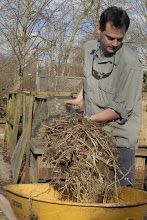
And so it was that a few weeks later in the hard rain of Vancouver's winter I found myself scurrying about in what was effectively a big dump with my little shovel making the first few uncertain steps of a earthen staircase down to the stream.

My new neighbor came out and asked, 'What are you doing down there?',

'I am a volunteer for Greenspace Vancouver', I replied somewhat dubiously.


Indeed, there was something almost obscene about digging about in this garbage pit. After all, I was doing this for free and with no permission from the city on whose land I was working.

Not to be deterred by the suspicious looks of passerbys and from my new landlord I plodded along carrying out the biggest pieces of garbage first before setting my sights on whatever else lay half exposed beneath the earth.

Months passed with no discernible progress. Regardless of how much garbage I hauled out from this little valley, there was more underneath. Wire, pieces of clothing, rusted pieces of machinery and sometimes the odd antique bottle or ancient farm tool in the form of a pitch fork or a horse shoe. Further down the stream I found the remains of a party from long ago including an old bottle of Chivas and a magnum of wine lying in the grass with an entire set of the type of kitchenware you'd expect to find in an affluent middle class household. But mostly it was just nasty garbage. The worst offenders were the pieces of broken glass and bits of sharp metal just waiting to make mincemeat of someone's unsuspecting digits.

But I plodded on. Eventually I made it down to mostly sticks and stones and earth.

On one of the few clear nights we'd had I looked out my window and for the first time realized that I could see the Fraser River. The Fraser comes all the way from the Rocky Mountains and is home to five kinds of salmon and the Sturgeon, or 'dinosaur fish', some of which can exceed five metres in length. This mighty river captivated my imagination and I hatched a plan to follow the little stream on my street down to the Fraser's banks and beyond.

First I had to finish my staircase down to the stream. But every time I would cut a stair into the earth the rain would wash away another. It was no easy task. In the woods were logs from trees that had been felled in years past and I used these wedging them into place with rocks hidden in the soil. At the most slippery part of the slope directly beside the stream I spent two months making an entire section of the staircase from rock alone. I somehow managed to lug these rocks, some more than one hundred pounds, by myself and fit them in place. Like icebergs once these behemoths were submerged into the bank it was impossible to judge their true size.


One day when the steps were nearing completion I finally decided to follow this stream down to the Fraser. After walking for a few minutes along the stream I came to a clearing and looked up to see a massive old craggy tree. On its highest branch were two eagles sitting in the sunlight.

Continuing on I came to another clearing with several beautiful pine trees. In the ground beside a different stream was the brick foundation of an old house. I followed the home's original path through this natural wonderland when suddenly I saw something hideous and totally out of place. A giant mound of sand fifty meters across and hundreds of meters in length brought this wondrous sanctuary to an abrupt end just beyond the eagles' tree. The Fraser River Perimeter Road!

Several years earlier I had heard of a plan to put a highway on either side of the Fraser and immediately grasped its implications. Why would anyone build a highway beside the home of the salmon? But to see it here made it all the more diabolical.

Passing over this sand trap I continued over a road where the stream passed through a pipe under the asphalt and out through the other side. It then flowed into a long canal which headed toward the Fraser. I followed it along the canal with my clothes getting caught on the blackberry bushes but it soon went under the fence and onto the property of CN land. From the 'no entry' sign I could see the Fraser not more than fifty meters in the distance! So close yet so far. My route was blocked.

I decided to follow the river along the closest road hoping that further along I could find a way to its banks. For several kilometers I walked in a spooky old area full of junkyards and barking dogs. Eventually I came to an old steel company that had been shut down. Massive coils of wire and other industrial equipment stood silent and rusting in the yard. A row of ancient turbine engines with 'Detroit Steel' on their sides had long ago ceased to run. I kept walking trying to find an entry to the Fraser but had no luck. I came to a pleasant forest but this soon gave way to the Perimeter road and another fence beside the railroad. Amazingly, despite being able to see the Fraser from my window I was unable to get to its banks even with a walk of several kilometers.

My plan to follow our little stream into the wilds of British Columbia had been crushed. Dejected, I turned around and made my way back through the forested area beside the steel plant. In the distance I saw some pink flowers and then a tiny hummingbird. This sighting lifted my spirits. I would content myself with the little stream on our street I told myself.

The highway might be approaching from all sides but I tried not to think about it. Instead I devoted my efforts to making this little waterfall an oasis. The fictional planet of Pandora in Avatar is really here on Earth I realized. Standing among the tall trees and large ferns all around me was a kind of blue green light created by the water and the forest. With my hands in the earth and falling sound of the water I was part of a fantastic world.

Several seasons passed since I first spotted this little treasure beneath the garbage. With my staircase looking more professional my neighbors started to be impressed with the beauty of this little spot. More than a few times I would walk past to see somebody staring down at the water. One night we saw a giant owl spread its wings and fly away from under the waterfall. Lovers started to make their way down the steps to be together in the forest. Another evening a shiny car drove past. It stopped and backed up as I poked around in one the little gardens I had made at the entrance of this green space. Was this another skeptic? coming to taunt me I mused when a lovely woman rolled down her window.


'I just wanted to tell you what beautiful work you do', she said before driving off.

But it wasn't long before I was paid a visit by another woman, this time from the city. After exchanging pleasantries, she came to her point. Looking at the fence which had bent just above where I had cut my trail, she said 'I like your work but it has caused some damage to this fence and we wouldn't want anyone to get hurt. Just so you know, your garden might be affected. It's a shame after all the work you've done', she added somewhat unconvincingly.

I too noticed the bent fence one day and big piece of the slope which had crumbled beneath it and realized it would mean trouble.

Then a couple of months ago, it came to a head when I was visited by a couple of different city workers as I was moving a big log.

'I like what you have done, but we are going to have to destroy it' said the older of the two workers who was wearing thick glasses which hid his eyes.

There was a younger guy with him wearing a glum expression ostensibly in disapproval at what they were being made to do.

Shocked I blurted out 'This was a dump when I moved here with garbage up to here', pointing to my knees.

'Well I am just warning you that we will be pouring 24” rocks in here tomorrow morning At 8 AM'

he told me.

'How far do you plan to go with them?', I asked in a panic.

'As far as they will roll', he answered looking at the beautiful pool of water beneath the waterfall.


The next day the trucks came with the rocks as promised while I was at work. I told my wife to go down to the green space we had built to make the city workers feel as badly as possible. Later my neighbour, a solid looking workingman told me he had also gone down to see what was going on and had told the workers that I had spent almost two years working on the staircase. 'Sometimes it's better to look the other way', he told them.

For whatever reason the green space and the little stream were saved that day. Nobody cared a whit about this little stream when it was a dump, least of all the city on whose land it runs. But since I started my project there has been enormous interest and dozens of workers surveying the area.

One reason for this is undoubtedly a result of the most vile thing I uncovered in this little valley when I was doing my work. Every time there is a heavy rain the whole stream turns into a toxic sludge of foam. It is clear from its volume that some type industry is dumping waste into this little stream which empties into the Fraser. But this terrifying fact had escaped detection until I had built my little path down to the stream.

I took a water sample of the sludge as well as some video and reported the violations to the provincial government. After weeks of calls to hapless officials I finally received a call from the provincial Ministry of the Environment informing me that this was a Department of Fisheries issue. The Department of Fisheries called me and said that it was the Ministry of the Environment's responsibility.

When I asked the person on the line to put that in writing, the line went dead.

Yesterday, two months after I filed my report we had our first big rain in recent memory. Returning home from the city I took a glance down at the little stream only to see it engulfed in foam two feet high.

The previous day I received an e-mail from a city worker in charge of the Surrey Beautification Program. Seeing the poster at our local library offering grants for those who have beautified Surrey's public spaces I made an application thinking our community green space would be the ideal candidate.

Instead the e-mail said that there were erosion issues with my project and so please cease any further work. When the city had threatened to destroy the greenspace because of erosion issues, I worked in the middle of the night to shore up the bank with logs and rocks. There were at present no erosion issues I assured the official and added that I learned from my neighbor that someone up the street who had damaged the fence and caused the erosion issue when he had lost control of his trailer which smashed into the fence bending it and knocking out the earth.

So I am not holding my breath for any awards from the city for my trail down to the stream.

But where there was once ugliness there is now beauty. At least for today.

.