Saturday, December 18, 2010

Conflict of knowledge (1)

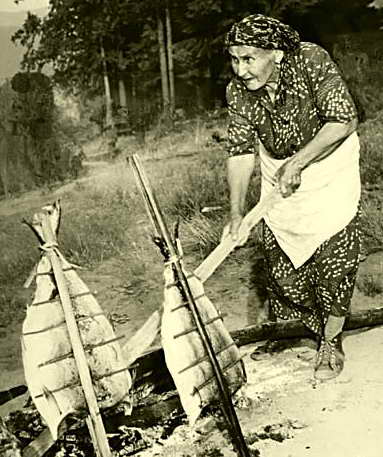
An elder of the Tsleil-Waututh Nation cooking salmon, c. 1940. 
Photo Vancouver City Archives, source www.firstnations.eu

Part 1

This past week, representatives of BC First Nations were called to testify before the Cohen Commission which is inquiring in the decline of the Fraser sockeye. The stated purpose of this week's hearings was to provide the Commission with insight in the worldview, cultural context and traditional knowledge of the aboriginal people in relation to the salmon. In total, 14 First Nations leaders appeared over a period of three days to provide their testimonies.

The hearings rapidly turned into a frontal assault against DFO, as the various indigenous leaders took turns to convey the same message to Justice Bruce Cohen: the Department of Fisheries and Oceans is a tyrannical and incompetent agency which dismisses aboriginal traditional knowledge, routinely tramples over basic indigenous rights, and accelerates by its mismanagement the decline of BC's wild salmon.

The attack on DFO was no accident, nor was it (at least solely) the result of the aboriginal leaders' personal frustration and sense of aggravation with this agency's incompetence. Rather, and more fundamentally, it was the expression of a head-on collision between two systems of knowledge, two incompatible worldviews.

Most aboriginal witnesses started their testimonials [1] by explaining the meaning of “traditional knowledge”. The First Nations possess a unique and invaluable knowledge of the salmon which has been acquired over thousands of years and is passed from generation to generation through oral tradition and direct experimentation, under the guidance of a parent or elder. A key characteristic of that knowledge is that it is not acquired in the abstract inside a classroom, but through concrete interactions with the land and the living beings which inhabit it, leading to a direct empirical understanding of how things are connected to one another. I grew up on a boat, Rod Naknakim of the Laich-Kwil-Tach said. The entire village was involved in salmon fishing. My grandfather told me about his father being a fisherman. Fishing, Grand Chief Clarence Pennier of the Sto:lo said, is a family function which you learn from your parents and grandparents.

Chief William Charlie of the Chehalis:

I used to fish with my grandfather. He would tell me which type of net I needed to bring to catch the fish that we would have in the water that season. I asked him: how do you know which fish we are going to have? He pointed to plants and birds and animals and said: when they are here, this is the kind of fish we get in the water. It's part of a system. (…)

We try to understand the full ecology cycle. When the pussy willows appear and the robins and black birds are coming around, that's when the early spring salmon come back.

Rod Naknakim:

I was always amazed how my grandfather knew the area and when the fish would come, and how many. He would whistle at the orca whales and they would rub against the boat. He was famous for predicting the size of a salmon run. He would get into fights with DFO, telling them 'there is a big run coming', and often he was right. The elders would know which run was which just by looking at a fish, mostly from its size and appearance. I used to know some of the differences myself when I was young.

Chief Fred Sampson of the Siska: [2]

Our traditional knowledge is very important. My grandmother knew. She would wait till the mock orange blossoms were on the trees and say “now we will go fishing.” “Why not before?” I’d ask her. I could see the fish going by. She'd say, “those fish belong to somebody else, the people higher up the river. It is only when the mock orange blossoms come out that it is our turn to fish.”

Chief William Charlie:

I have a cousin who works in one of the spawning channels. He works with SFU. He would say: this one spawned, this one didn't but tried to, etc. And the SFU people were able to sample the fish and verify and confirm what he was saying. That knowledge was passed on to him by his father and grandfather. We need to integrate this knowledge with technology and modern tools.

In this worldview, having practical knowledge of a particular ecosystem cannot be dissociated from living in that ecosystem and depending on it for daily subsistence. This is why the witnesses, as they spoke before the Commission, tended not to separate factual knowledge from cultural tradition from dietary habits from stewardship of their land. Salmon are in our songs, dances, carvings, Rod Naknakim said. Twins in our family had their own salmon song to signify abundance, Chief Robert Mountain of the Namgis said, and he then added: when I was a child, we would live on the sockeye, we would eat sockeye three times a day and then we would have sockeye as snacks. Councilor June Quipp of the Cheam: we have to respect the salmon because it is such a big part of our lives. I teach my children and grandchildren about the meaning of the salmon and how we cannot waste that food.

Chief William Charlie:

Salmon contribute to the physical, spiritual, and social health of our people. When salmon has been a major part of your diet for so many generations, it becomes a part of you. It becomes soul food and medicine. You crave for it, you become anxious for it when the fishing season comes upon us.

When asked to define what stewardship of the salmon meant to him, Chief Charlie explained: stewardship is how we conduct ourselves to ensure that all living things carry on. We don't want to be the generation responsible for losing something, especially not the salmon.

DFO, however, does not recognize aboriginal knowledge as being useful or relevant to its mandate and, according to the witnesses, dismisses it altogether as being pseudo- or at best anecdotal knowledge. When asked by her legal counsel how DFO deals with her culture and traditional knowledge, Councilor June Quipp responded: They are in denial. They ignore our culture, they don't use their mandate to deal with it.

Chief Fred Sampson: [2]

The traditional ecological knowledge is not acknowledged, not respected by the scientists, by the management. We believe our traditional ecological knowledge is very important in caring for the fish. They [the scientists] would say “you just don’t understand the science” and we will say, “no, you don’t understand the role that traditional ecological knowledge plays.”

That denial is unfortunate according to the witnesses, since DFO is itself perceived by many First Nations as being a deeply ignorant organization which would gain much from tapping into some of the accumulated aboriginal knowledge. Such knowledge would help them, for example, to avoid some basic and rather embarrassing mistakes as they fumble to gather information on fish stock sizes. Chief Robert Mountain:

When I was a commercial fisherman, we were wondering what DFO was doing, fishing on the biggest tides when it was dangerous. They were doing tests at the wrong times when there was no fish, so their numbers on how many fish were out there were not accurate. DFO was doing the wrong tests at the wrong times in the wrong areas – and that's too bad, because our elders had, and still have, that knowledge.

The legal counsel of Chief Edwin Newman of the Heiltsuk produced a handwritten map maintained by the band, showing all the salmon-bearing streams and creeks in his territory. Most of those streams don't bear salmon anymore because of bad logging practices, Chief Newman commented as the map was being projected on the courtroom’s computer screens. We attempted to restore some of them, but we were told not do that, not to interfere with that. The map was entered as evidence in the Commission’s proceedings. On a similar note, Chief Robert Mountain commented:

I am concerned about the assessment done [by DFO] in the creeks. A lot of creeks are not recorded, even though we would see tens of thousands, sometimes hundreds of thousands of salmon in those streams and creeks. There was a noticeable drop in the past 20 years. I used to swim in streams with 20,000 sockeye, and now there are maybe 1,000 of them.


[1] I am using quotes from aboriginal leaders which I transcribed to the best of my ability as the testimonies were being given at the Commission. While my transcriptions accurately convey the meaning of what was said, they may not always reflect the exact words used by the witnesses. For that, we will have the official transcripts which should be posted on the Commission's website within the next couple weeks. To indicate that my quotes are true in their content yet not necessarily exact in their form, I am using italics and no quotes whenever quoting an aboriginal witness.

[2] I was not present on the second day of the testimonials and so for those, I am relying on the transcripts provided by fellow activist Elena Edwards.


Tuesday, December 14, 2010

Selective science

The Fraser sockeye - a run facing a unique "boom and bust" challenge. 
Photo Isabelle Groc, Tidelife Photography.

An important blog posted today by Alexandra Morton deals with the role of science in the ongoing struggle to save BC’s wild salmon.

She starts by giving a quick analysis of a scientific paper published yesterday which discounts sea lice as a primary cause to recent wild salmon declines. “The authors state they won the trust of the Norwegian feedlot companies”, she writes, “and present conclusions that run counter to science published across the North Hemisphere. They don't report on why their results are such distant outliers to the scientific weight of evidence that wild salmon populations go into steep decline wherever there are salmon feedlots. They suggest something else must be killing young wild salmon near salmon feedlots, but they don't [say] what that could be.”

Further down in her blog, while not discounting climate change as a long-term factor in the Fraser sockeye decline, she remarks that other sockeye runs did not boom and bust as the Fraser run did and “so it would seem the Fraser sockeye are facing a unique challenge and that ocean conditions assist or aggravate whatever the problem is.” She then adds the following:

“Of concern is that scientists are not talking about the evidence that DFO has found a "novel" virus that appears to be compromising specifically the Fraser sockeye that travel north out of the Fraser through fish feedlot effluent. The technique examines the RNA of the sockeye and this has never been done before in fish. However, the methods are sound and suggest a retro virus is infecting the majority of Fraser sockeye that travel along the east coast of Vancouver Island. It is not being found in the sockeye that come in from the open ocean via Juan de Fuca. In a leaked briefing [obtained] by the Globe and Mail, it would appear DFO believes this is one of the three most likely causes of the 2009 collapse and yet no one is mentioning it.”

Alex Morton’s comments reinforce my own direct observation that some scientists appear to be engaged in what I can only describe as a practice of “selective hypothesis making” consisting in over-emphasizing certain scientific explanations while downplaying others, with no detectable consistency or method as to how such selections are being performed.

That's a big problem, because scientists enjoy a natural prestige and legitimacy in society by the sole virtue of being who they are. A PhD, a professorship carries a certain weight – one may say inertia – in our collective belief systems. As such, and unlike what the dominant mythology would have us believe, a scientist’s opinion is anything but neutral.

How to account for this tendency by some scientists to engage in selective hypothesis formulating? Scientists at least in their overwhelming majority are honest and highly ethical individuals, and therefore plain corruption or sell-out to the highest bidder does not account for that phenomenon. A more plausible explanation lies in the considerable (and truly irresistible) pressures being exerted on research teams by market forces in a fashion very similar to those applied on a routine basis upon our politicians.

Large transnational corporations, unlike civil society, have long abandoned the myth of "scientific neutrality" and have instead identified scientists and researchers for what they are: a malleable political material carrying a strong potential for influencing public opinion, and as such a force which ought to be channeled to one’s benefit. Since most scientists have too high moral standards – or opinions of themselves – to be simply bribed, the research system itself needed to be corrupted. This has been accomplished over the past 30 years of neoliberal regime through the systematic privatization of research funding. I challenge the reader to identify more than a handful of large research projects in North America today which do not rely mainly on private funding for their perpetuation (after one has discounted US military research, which represents a totally different beast and I won't even touch it here).

In a system of privatized research financing, researchers no longer have a choice but to comply with, or at least take significantly into account, the exogenous pressures which corporations exert upon them. They are submitted to market forces, having to sell their research projects like so many commodities, competing with one another for access to funds, forced to give their funding sources a say in the nature, direction, and results of their research. Research directors would be highly irresponsible not to allow this to happen, given that their research team’s payroll and livelihood for the next few years may indeed depend upon it.

It’s a subtle game, of course. First, there are often intermediate funding organizations with neutral-sounding names standing between research labs and their corporate sponsors, making linkages from one to the other harder to trace. Second, researchers don’t decide consciously and cynically to dismiss a perfectly valid hypothesis in favor of a doubtful one in order to please a private funder. Rather they learn, often at an unconscious level, to modify the research directions that they provide to their staff. To ponder every word in their communications with the public in a manner that does not unnecessarily aggravate powerful interests. To master the art of compromise, of performing daily self-censure on peripheral aspects of their research so as not to endanger what they consider to be the core. In a word, they learn the difficult, mostly foreign to their culture, yet necessary, trade of politics.

And guess what? We activists engaged in the fight against “evil” corporations are no different, not in the slightest. We slant, bend, interpret science in a direction favorable to our own agendas on a continual basis just as corporations, governments, and scientists do. Truth is not an idea which somewhat awaits in hiding to be uncovered. It is a dialectical process. A synthetic, contradiction-ridden knowledge base which is continuously set in motion and transformed by a succession of crises and clashes. This is, after all, how evolution works. To think that scientific truth is any different would be foolish. 

We who are participating in the struggle to save the Fraser salmon from extinction are actively engaged in one such clashes of knowledge. The fight for truth is always political in nature. In the case of scientific truth, that political struggle must be waged using scientific tools. If we pay attention to the manner in which Alex Morton responds to the research paper published yesterday, she does not respond using ideology. Instead, she uses rigorous scientific methodology, asking for example why the authors don’t explain how their findings are such distant outliers to previously gathered scientific evidence – a basic question in the scientific peer-review process. In a follow-up post, she adds: "If these authors want to champion their methods they need to explain why it is more accurate [than that of previous research teams]."

The sooner we accept and embrace the objective reality that scientific truth is a hard-fought, hard-won political struggle which is waged using a rigorous scientific arsenal – and yeah, a healthy but always marginal dose of polemics –, the quicker we may get to work on counteracting the tremendous power that large corporations have mustered in influencing and controlling the production of scientific knowledge.

.

Thursday, December 9, 2010

Salmon think tank gives lesson in (political) science


The Alaska sockeye have not undergone the same population swings as here in BC: a stream in Alaska. Photo alaska-in-pictures.com

Last Monday, a panel of scientists convened at the SFU Harbour Centre to present its preliminary findings on the dramatic variations in the Fraser sockeye populations. In a single year between 2009 and 2010, those runs went from catastrophic (1.7 million) to legendary (29 million).

The  main message of Monday's presentation, at least I think, was intended to be one of scientific caution in the face of a bewildering swing of events. This year’s record return has opened a lot of questions, panel chair Mark Angelo offered as an introduction. Surprises should no longer surprise us, John Reynolds of SFU said, it is the new norm and only safe prediction as we ride this rollercoaster. There is an expectation that we scientists can explain all of this, Brian Riddell of the Pacific Salmon Foundation added, but we can't really. – Etc. You get the idea. The humble “I know that I know nothing” Socratic paradox. And in all fairness, if uncertainty was the only finding that those scientists could produce in the aftermath of such contradictory events, I would have been fine with that.

Scientific caution, however, did not last for very long on Monday night as John Reynolds gave us a quick run through the main causes identified by the panel for the sockeye's wild swings. There is a confluence of two or three factors, Reynolds said, and in our opinion a primary one is climate. There was a dramatic cooling of the North Pacific Ocean in 2008, he explained, and the panel feels very strongly that it played a massive role in the 2010 turnaround of the Fraser sockeye.

A massive role? That's a massive statement coming from a scientific panel which had just finished explaining that we really don’t understand much about what's happening to our salmon. Ten minutes into the presentation, and the panel was telling us in essence: sorry folks, climate change did it, there is really nothing you can do, go home and we'll keep you posted. The implicit corollary to this statement, of course, was pretty clear to the 150 people in attendance: if climate change is indeed the primary factor, then fish farms have nothing to do with the decline of the sockeye. As for the specific details of how the panel had reached such a compelling conclusion, Dr. Reynolds did not deem necessary to explain them to the audience. Without further ado, we were ushered on to the next topic.

That next topic, it turned out, was worth its while. It was a presentation of the findings of an original field research conducted by Brian Riddell. It involved the radio-tagging of two hundred Fraser sockeye smolts which allowed the researchers to plot their routes as they left Chilco Lake down the Fraser and then through the Georgia Strait. Only 40 smolts made it alive to the mouth of the river, and 5 to the top of Queen Charlotte Sound, suggesting that some very heavy mortality rates were occurring first inside the river, and then in the Georgia Strait before the juveniles could reach the open ocean. Riddell concluded his presentation by making a rather sound recommendation that scientists should focus their field research efforts on Johnstone Strait, a narrow stretch of water in Northeast Vancouver Island which the sockeye travel every year and which is relatively easy to monitor.

And with that, we moved on to the question period. The panel had managed the exploit of reaching that stage of the evening without even using a single time (to the best of my recollection) the two phrases which were on everyone else's minds: “fish farm” and “salmon virus”. The audience, however, was less kind to the fish farm industry than the panel members. People made it immediately clear through their questions that there were some other strong hypotheses to explore in addition to climate change. The first question of the public was about salmon viruses; the second, about fish farms. A recent Globe and Mail Freedom of Information request has revealed, the first member of the audience said, that DFO has known for almost a year about a viral infection causing brain lesions to the Fraser sockeye. Why has DFO omitted to inform the public about such a critical piece of information? Kristi Miller, a research scientist with DFO, has been studying this potential viral disease for some time, he continued. Yet her work is being systematically embargoed and almost never mentioned in scientific conferences and research panels across the province – Why?

Brian Riddell gave one of those Byzantine and tautology-rich responses which senior researchers well honed in the practice of bureaucracy hold the secret to. This disease is virus-like, he said, it has not yet been formally identified as a virus. The samples and data are being sent around to labs. Unhealthy fish have higher mortality rates – so we don't know if deaths are solely caused by the lesions. It's a very long process which has to go through a stringent embargo. It is premature to say that there is a link between virus, brain lesion, and higher mortality rates, he concluded.

I learned later that night from Alexandra Morton, who is herself a trained biologist and has read Miller's research, that we already know that this brain lesion is contagious. Contagion typically involves some form of organism such as a virus, and so in fact there is already a strong presumption that we are indeed dealing with a virus.

In a follow-up question about the high mortality rates observed in the Fraser River, Riddell dismissed viral disease as a possible cause, because the seven days that the salmon take to travel down the river do not provide enough time for a virus to run its deadly course. But his dismissal relies on two assumptions that (a) the virus has a rather long incubation period (unlike the common flu for example which only needs two days) and (b) the fish were healthy when they left their holding lake.

The second person to address the panel noted that the Harrison River – a tributary of the Fraser – has witnessed a good sockeye run in 2009 while the rest of the watershed system crashed. Is it a coincidence, he asked, that this particular healthy sockeye run is also among the rare ones which travel South through the Juan de Fuca Strait, a route which has almost no fish farms on it, while most others use the fish farm-infested North route through Johnstone Strait? Good question, we don't have enough data on the Harrison sockeye, was the laconic answer by the scientific panel. One of the panelists did venture out of the safe zone, however. He acknowledged that fish farms did represent a significant change to the conditions in Johnstone Strait, along with climate change. Finally! Someone on the panel had uttered the 'F' word (as in farms).

I came out of this panel presentation my head spinning with questions. Why make climate change the overriding factor in the instability of the BC sockeye runs? The climate change hypothesis is weak to say the least in accounting for the dramatic boom-bust cycles that BC has known over the past decade, for several reasons. Neighboring Alaska has known very good, and more importantly, very steady salmon runs in the past decade while ours were swinging up and down like a broken thermostat. Alaska's clockwork regular sockeye harvest numbers should give us pause, and make us wonder what is specifically wrong with our own runs. In BC proper, the climate change hypothesis does not appear to account very well for intra-regional differences either. The Harrison sockeye run's good numbers during the otherwise catastrophic 2009 year is a case in point. Another one is the fact that so many Northern BC runs have fared poorly this year, during the so-called “legendary” run of 2010.

Alaska sockeye harvests
(source: Alaska Department of Fish and Game)


2005        43.3 million
2006        41.8 million
2007        46.3 million
2008        39.1 million
2009        43.3 million
2010        41.0 million

I am not dismissing climate change which could very well be a factor in long-term sockeye declines. Rather, I am saying to this panel: if you want to make climate change your primary cause in the sockeye's short-term misfortunes while dismissing other good hypotheses as you did on Monday, you're going have to do much better than a few broad generalizations on the shifting climate conditions over the Northern Pacific in 2008. Why be so trigger-happy on climate change, yet so conservative and reluctant to acknowledge Kristi Miller's virus hypothesis, which – if I believe my sources –  is about to be published in the journal Nature? And what's so hard to believe about that hypothesis anyways? After all, a virus is what wiped out Chile's salmon fisheries only two years ago.

One (non-scientific) problem with the viral disease hypothesis, of course, is that it may create a strong link between salmon decline and fish farms. That is what the Chilean case has so tragically illustrated. The climate change hypothesis, on the other hand, carries the great advantage of being a rather “soft” and non-confrontational thesis, one that is not liable to aggravate some powerful interests such as the aquaculture industry. This is not to suggest that this scientific panel is being dishonest or corrupt about its scientific positions, there is no reason whatsoever to believe that. But, in a time of extreme scientific uncertainty over BC's wild salmon runs, climate change is a good “middle of the road” position to adopt if one is seeking to park oneself in a-wait-and-see spot, if one wants to somehow hedge one's bets and stay put until things decant a little, scientifically speaking, and until it becomes safe again to commit oneself to a strong scientific hypothesis (whether viral disease or other) without having burnt too many bridges along the way. In a word, the climate change hypothesis is good politics.

Invoking climate change as the primary cause behind BC's wild salmon's decline, however, is anything but neutral. It is extraordinarily disempowering for people, it gets the fish farm industry off the hook before we even get to study their fish disease data, it undermines critical scientific research such as that carried by Kristi Miller on the viral infections, it allows both the BC government and DFO – this broken institution – to continue their bankrupt policies of business as usual. It is a scientifically lazy niche to occupy, all the while some concrete and heroic scientific research work needs to be urgently accomplished on the ground. Brian Riddell's smolt radio tagging project, and his proposed monitoring of Johnstone Strait, are prime examples of such critical work. Miller's infection work is obviously another one. Studying the Harrison River sockeye may yet be another one, since the panel acknowledged on Monday that the data for that key run is lacking.

This panel needs to remain focused on its core scientific mandate. Acknowledge that the scientific community is unable to reach meaningful conclusions on the Fraser sockeye for the time being. Demand, as it claims to have done in the past, that the fish farm industry release all of its disease-related data to the scientific community and the general public by way of an open website (and not only to Justice Bruce Cohen for the sole purpose of his Inquiry). Continue to promote critical hands-on field research to gather more data. And stop dangling climate change as a catch-all explanation to everything – unless, that is, they are onto something specific which looks as promising as Miller's research on the viral disease. In which case, they need to tell us what it is they have discovered. What they did instead on Monday night is to tell us that “it's climate change, now go play in your room”. It's just too short an explanation for so big an issue. And I, for my part, don't like to be patronized.

.

Friday, December 3, 2010

What Is a College Degree Worth in China?

A job fair for college graduates in Hefei, China. Photo New York Times.
An interesting New York Times panel discussion about the value of college degrees in China. The article frames the problem in the following terms:

"While China's economy keeps growing at a rapid pace, the dim employment prospects of many of its college graduates pose a potential economic problem.

According to recent statistics, the average Chinese college graduate makes only 300 yuan, or about $44, more a month than the average Chinese migrant worker. In recent years, the wages of college graduates have remained steady at about 1,500 yuan a month. Migrant workers' wages, however, have risen to 1,200 yuan.

If China's graduates are unable to capitalize on their costly investment in education, then is it worthwhile for students to obtain a college degree? What does the imbalance say about China's education system and its economy in general?"

We're hitting here one of the classical choke points of capitalism: surplus-value has to be extracted somewhere from workers in order for capitalists to make a profit. Today, that somewhere is China.

As one of the panelists puts it, "Despite all the hoopla that foreign analysts have heaped on China’s growth, the economy remains driven by manual labor, low-cost and low-margin manufacturing. (...) Knowledge production requires an elite but an extraordinarily small number of workers. As a result, it cannot absorb many college graduates." The room for a Chinese middle class is thus extremely narrow, hence the chronic oversupply of worthless college degrees.

China's way out of this contradiction (within the limits of capitalism, that is) is to build its own economic empire, i.e. export its manufacturing jobs to undeveloped regions such as Africa, keep its "command and control" jobs in China, and have its own middle class live off the exploitation of Africa's manual labor, as the U.S. and Europe have done for the past century throughout the world. Until the next crisis of overproduction. Meanwhile, entire generations of Chinese college graduates are condemned to fight over the few qualified jobs available in their country - thousands of applicants for every job, it is said.


.

Thursday, December 2, 2010

Saying No to logging on Flores Island

Flores Island, Clayoquot Sound. Photo Wilderness Committee.
This from the Wilderness Committee:

We have recently learned that there is a plan to log a pristine old growth valley on Flores Island in the heart of Clayoquot Sound. The company has marked out its planned cutting areas and is preparing right now to obtain logging road and cutting permits from the Provincial Government.

Write the Minister of Natural Resource Operations, Steve Thomson now and ask that no road or cut permits be issued for Flores Island or any other intact areas in Clayoquot Sound's rare, ancient temperate rainforest.

Together we can get this done!

Joe Foy | National Campaign Director
Wilderness Committee


My letter to the Minister:


Dear Mr. Thomson,

Okay this one – hopefully – should be really easy for you to decide upon.

Who in the world is this company which wants to log the trees of Flores Island? Have they lost their senses? What a silly move on their part. Logging Flores is not going to happen, it's as simple as that. It won't happen, I might add, with or without your government's consent. You would have entire communities – and not just the local ones – walking massive marches to Victoria and raising human shields and going all guerrilla on you before the first giant tree of Flores is allowed to be felled.

What government in its right mind would want to tie its name to such a doomed adventure? I know the Liberals have made some pretty outlandish decisions in the past few years, but here is one where you are actually liable to side with the decent, reasonable, normal people, rather than with the occult corporate forces which your government usually serves so obediently.

Your government should try “good decision” before it is ousted out of power, just for size. Come on Mr. Thomson, you can do it!

Ivan Doumenc
Vancouver, BC

.

Saturday, November 20, 2010

India's best export

Arundathi Roy. Photo Wikimedia
Activists fighting private power projects in British Columbia are so absorbed in their local struggle, that we easily forget how much this battle is truly global in nature. That point was carried home back in 2001 in a book by Indian novelist, essayist and activist Arundathi Roy, Power Politics.

The book tells the story of the controversial 400MW Maheshwar hydropower project on the Narmada river in central India's state of Madhya Pradesh, which according to watchdog organization International Rivers will submerge, if completed, the fertile lands and homes of about 100,000 people.

That private project was initially structured as a joint venture between US incineration giant Ogden Energy Group and Indian textile company S. Kumars. Since then it has descended, as so many other projects of its kind, into an investors' nightmare and Ogden has walked away. But the project has managed to survive and is now 80% complete, in spite of fierce resistance by the valley's population, continuous and repeated environmental and contractual violations at every step of the way, legal battles of epic dimensions, and a recent order by the central Indian government to temporarily interrupt construction - an order contemptuously ignored by the developer which has continued construction of the dam with the support of the state government.

Arundathi Roy's book is available at the Vancouver Public Library's central branch (Call # 320.954 R88p) and is worth being read cover to cover, but here are a few passages particularly relevant to our own situation in British Columbia:

The cost of the electricity [produced by this project] at the factory gate will be 13.9 cents per kilowatt hour, which is 26 times more expensive than existing hydroelectric power in the state, 5.5 times more expensive than thermal power, and 4 times more expensive than power from the central grid. (It's worth mentioning here that Madhya Pradesh today generates 1,500 megawatts more power than it can transmit and distribute.)

Though the installed capacity of the Maheshwar project is supposed to be 400 megawatts, studies using 28 years of actual river flow data show that 80% of the electricity will be generated only during the monsoon months, when the river is full. What this means is that most of the supply will be generated when it's least needed.

S. Kumars has no worries on this count. [...] They have an escrow clause in their contract, which guarantees them first call on government funds. This means that however much (or however little) electricity they produce, whether anybody buys it or not, for the next 35 years they are guaranteed a minimum payment from the government of approximately $127 million a year. This money will be paid to them even before employees of the bankrupt State Electricity Board get their salaries. […] 

To date, S. Kumars hasn't even managed to produce a list of project-affected people, let alone land on which they are to be resettled. Yet, construction continues. S. Kumars is so well entrenched with the state government that they don't even need to pretend to cover their tracks. […] 

What they don't realize is that the fight is on. Over the last three years, the struggle against the Maheshwar Dam has grown into a veritable civil disobedience movement, though you wouldn't know it if you read the papers. The mainstream media is hugely dependent on revenue from advertising. S. Kumars sponsors massive advertisements for their blended suitings. After their James Bond campaign with Pierce Brosnan, they've signed India's biggest film star - Hrithik Roshan - as their star campaigner. It's extraordinary how much silent admiration and support a hunk in a blended suit can evoke. […]

Over the last two years, tens of thousands of villagers have captured the dam site several times and halted construction work. Protests in the region forced two companies, Bayernwerk and VEW of Germany, to withdraw from the project.”


The similarities between India's Maheshwar project and our own “run-of-river” schemes are painfully evident, only perhaps a little more extreme in their Indian manifestation. Roy's book demonstrates that there is not only a global agenda of private appropriation of public resources. There is also a proven methodology, a transferable know-how, a reusable template according to which such appropriations are performed. What is being done to our rivers in BC today by the ruling class has been tried and tested and fine-tuned elsewhere in the world many times over.

As such, when fighting our local battles to reclaim our commons from the ruling class, it's simply not good enough to keep it local. Thinking globally while acting locally is a slogan which does not cut it anymore. We must act globally too, constitute a transnational movement of organized political resistance which actively connects like-minded movements worldwide.

Elsewhere in her book, Arundathi Roy writes that what we need is a new kind of politics:

“Not the politics of governance, but the politics of resistance. The politics of opposition. The politics of forcing accountability. The politics of slowing things down. The politics of joining hands across the world and preventing certain destruction. In the present circumstances, I'd say that the only thing worth globalizing is dissent. It's India's best export.”

Such an organized political resistance is indispensable indeed if we are not to constantly reinvent the wheel at every new local battle, and therefore inevitably lose every such battle as we fruitlessly attempt to reinvent its particular rules of engagement.

We all know that the climate summit in Cancun next month will amount to nothing at all in terms of measurable results. Yet it could achieve a lot - possibly even more than Copenhagen, precisely because it will be relieved of the pressure of having to deliver any "results" - in terms of building the global organized political force of resistance that Roy and other leaders are calling for. An organization which will federate and reconcile heterogeneous and often mutually class-antagonistic movements such as climate justice and anti-WTO, landless peasant and indigenous rights, armed insurgencies as in India's northern and eastern regions and classical industrial workers' movements as the ones now emerging in China. A movement which unifies topics and regions under a common struggle to rid the world of the plague of neoliberalism.

In other words - and to shamelessly use some outdated and historically tainted terminology - what we need today is an International.

.

Tuesday, November 2, 2010

How Marine Harvest stole the fish farms

An enclosed, land-based aquaponics fish farm. Photo socialearth.org
The public overwhelmingly supports Alexandra Morton's campaign to remove open-pen fish farms from BC's waters. In particular, Alex's recent demand that fish farms disclose all their disease-related data since the beginning of their operations is extremely well received in the general public. It is fair to say that, today, the campaign has gained tremendous momentum and could be reaching critical mass. Victory is now a clear and distinct possibility.

Those observations made a recent conversation I participated in all the more distressing.

I was meeting with an old friend at a coffee shop and he introduced me to two of his friends. The conversation rapidly landed on the topic of fish farms. They were both enthusiastically sympathetic to Alex's cause. I was cruising, enjoying the pleasure of finding myself in such friendly territory without even having to work at it. Then one of them said: you know, the problem with farmed salmon is that it tastes awful. The wild salmon has this “gamy” flavor which cannot be replicated in a fish farm.

Whoa, hold it there buddy. I was stupefied by what I had just heard. Is that what we have reduced the wild vs. farmed salmon issue to –  a mere consumer debate?

I told my new acquaintance that if, tomorrow morning, Marine Harvest got its act together, took all of its fish farms out of the ocean and brought them inland into properly contained systems, I would applaud loudly. That, moreover, if Marine Harvest took the additional steps of rendering its farming operations sustainable by (a) finding alternative feed sources to ocean fishing by-catch and (b) ensuring the proper recycling of its waste – I would become Marine Harvest's most faithful customer.

As for the actual taste of salmon, I told him, I couldn't care less.

I love the taste of sockeye, don't get me wrong. It's one of my most intense and rewarding culinary pleasures in life. But I would give it up without hesitation if that could save this magnificent species from extinction. Hell, I've already done that! I have hardly eaten any sockeye in the past 3 years because of collapsing runs. In 2010, I have feasted on sockeye knowing full well that I may have to renounce it for good as early as next year. Because – no matter how tasty the flesh of a sockeye is – it does not come close to the transformative experience of watching the sockeye return to its river to spawn.

Why in the world did I have to remind this well-intentioned person of such basic and self-evident truisms about wild and farmed salmon? How did we ever get here?

It made me realize that Marine Harvest's impact goes further than just the potential eradication of the wild salmon itself. Another secondary and far reaching impact is that, through its operations, this corporation is instilling in people a deep and long lasting hatred for fish farming in general. The problem is that if we start hating fish farms, we and the oceans are in deep, deep trouble indeed.

Fish farms were supposed to be a positive and workable solution to the awful plague of ocean overfishing. High-tech farms, that is: farms which are enclosed, running in a closed cycle, producing their own feed through a combination of plants, worms, non-carnivorous fish, and predator fish (a technique sometimes known as aquaponics). Farms which do not overcrowd their fish or replicate in the ocean the scourge of land-based factory farming.

In our ongoing struggle to save our wild salmon, it appears that we are – once again! – fighting on the terms set by the corporations rather than our own. We are asked to choose between two impossible evils: destructive, overcrowded, ridiculously low-tech operations consisting literally of a net thrown in the ocean which the industry has the nerve to call “fish farms”. Or, the continuation of mindless overfishing of the ocean, down to the very last wild fish. Are we learning anything yet? We must reject both alternatives and proudly advance our own progressive agenda, our own solution to the tragic depletion of our oceans: fish farms!

In that regard, we must listen to Alex Morton's core message more carefully. She is and has always been a fervent advocate of contained land-based fish farms, provided that they are run under sustainable conditions. We need to ensure that we remain focused on that message and that we communicate it clearly to the general public. We LOVE fish farms and we WANT them, and Marine Harvest's operations DO NOT constitute fish farms.

As such, any part of our campaign that depreciates farmed salmon (e.g. popular slogans such as “farmed salmon sucks”, “tastes awful”, is a “freak of nature”, “has two heads”, etc.) is misplaced and actually counterproductive. We should instead glorify this magnificent animal, the Atlantic salmon, and recognize it as our objective ally in the battle to save its brother the Pacific salmon. Atlantic salmon are good! They taste good! They could taste even better with the proper application of technology and know-how! Contained, high-tech fish farming is good! The overfishing of wild salmon is evil! Marine Harvest's usurpation of the term “fish farm” to describe its nets in the water is evil!

Perhaps a more progressive, although slightly more complex, slogan for the general public would be something along the lines that “We want to reclaim fish farms from Marine Harvest”.

As I indicated at the beginning of this post, there is a distinct and reasonable probability of us actually winning this campaign. This poses the practical question of what happens after we win.

1. Will we win on time? Will it give the wild salmon a chance to rebound, recover, and adapt to other threats such as overfishing, loss of habitat, and (perhaps) climate change?

2. What will be the cost of this victory to the reputation of aquaculture and fish farming in general? A key question indeed, given that we need fish farms to save our oceans and, therefore, our wild salmon.

Once Marine Harvest has been forced to remove its despicable open-pen fish operations from our waters, do we just mindlessly go back to overfishing the ocean and eradicating our wild salmon through criminal mismanagement, DFO-style? No, of course not! From there, we move on to fish farms. Real fish farms, enclosed, high-tech, sustainable ones.

By denigrating fish farms as we sometimes do, we are cutting the branch we are sitting on. We are contributing to bankrupting in advance any chance of establishing viable commercial aquaculture operations as an alternative to killing our oceans. Yes, we need to - and we will - get Marine Harvest's factory nets out of the water. But we also need to stop undermining fish farms. Now.

.