Sunday, August 28, 2011

Kristi’s choice

Dr. Kristi Miller (Head, Molecular Genetics, DFO). Photo Globe and Mail.


Reckless sabotage. Bureaucratic harassment. Financial starvation. A quasi-religious resistance to novelty. And a good dose of incompetence.

That is the mix that the Department of Fisheries and Oceans has prepared for Kristi Miller, with the incredible result of bringing her critical research on salmon anemia to a complete halt. Or so we learned this past week at the Cohen Commission. As I write these lines, Kristi Miller’s research is fully stalled, with no money allocated to it and no clear indication on how long it may take to get it moving again.

How did they stop it? By using what scientists living at the top of the intellectual food chain do best: a mind game. Consciously or not (that part remains to be seen), senior management and high-ranking scientists of this bureaucracy have blocked Miller’s work by using a circular argument which holds in 4 simple statements:

1. We don't know that there is a disease.
2. We won't take any action until we know that there is a disease.
3. We make sure that our scientist cannot find whether there is a disease.
4. Therefore, we don't know that there is a disease.

We don't have hard evidence of a pathogen affecting wild salmon, Dr. Michael Kent (ex-DFO, currently Professor of Microbiology at Oregon State University) stated on the Commission’s witness stand. Without more research, it is purely speculative to say that the virus uncovered by Kristi Miller was a significant factor in the 2009 collapse, said Dr. Kyle Garver, Research Scientist at DFO. Some of the interpretations and assumptions that Miller makes in her research may be speculative or overreached, said Dr. Christine MacWilliams, senior fish health veterinarian at DFO. (A stunning comment given that MacWilliams did not feel it was necessary to explain what she meant by that.)

To some extent, Kristi Miller herself adheres to such views about her research, notwithstanding the personal and unsubstantiated attacks carried by some of her colleagues. She agreed that there is no conclusive evidence yet linking virus to disease, or fish farms to wild salmon. But there are some pretty good indications that this may indeed be the case, “a smoking gun” as she put it to the Commission. There is a distinct genomic signature found in the Fraser sockeye, there is a virus which may be linked to that signature, there is evidence of anemia and leukemia in many infected wild salmon, and there is a dramatic decline in the sockeye population in the Fraser. And so, one may conclude, there is ample and urgent justification for pursuing Miller’s research forward at DFO’s earliest convenience.

Given the promising and novel nature of Miller’s findings and level of interest it has generated in the scientific community at large – her research was recently published in the journal Science –, the amount of resistance she has encountered at DFO from her own colleagues and management is staggering. In 2009 for example, Kristi Miller prepared a memo to her senior management alerting them over the “potentially devastating impacts” of the discovered disease on the sockeye. Dr. Kyle Garver, who was asked to review the memo, attempted to water down its contents. Alexandra Morton’s lawyer, Gregory McDade, asked Garver about this particular incident during a cross-examination at the Cohen Commission:


McDade: When a senior scientist at your department says “potentially devastating impacts”, that's a significant finding for you, is it not?


Garver: I'm sorry – for me?


McDade: What I am trying to get here is a sense of what level of certainty you need about a potentially devastating impact to the sockeye salmon to actually take action, rather than more studies. How far do we have to go in proof?


Garver: We’re following a scientific approach, so we need to establish that this sequence is indeed causing a disease.


McDade: And you are not prepared to recommend an action to your senior people at DFO until you’ve done all of these laboratory studies and have found proof to your satisfaction?


Garver: Until I find that this virus is causing disease, and that it is indeed transmissible, then I probably would not recommend action at this time.


The resistance to Miller’s findings at DFO did not always follow a strict scientific approach either, and sometimes verged on the irrational or even the supernatural. In a memorable meeting, for example, Dr. Christine MacWilliams explained to Kristi Miller that all possible pathogens affecting sockeye had already been discovered and that, therefore, there was no room for any “novel undescribed” pathogens. Science, MacWilliams was telling Miller, had ended its journey. There was nothing else to discover. We, at DFO, already hold all the knowledge that there is to hold. Search no more! All truth has been revealed. Another colleague, according to Miller, stated to her that he “did not believe that marine anemia truly exists”. As if the existence or nonexistence of such diseases was a matter of faith, rather than scientific observation.

Confronted with such a wall of resistance, Kristi Miller, a pragmatic person, decided to change her tack. They wanted a causal viral agent linking her genomic signature to an actual disease before she could pursue this further? Okay then, she’d focus her work on identifying that causal (or etiological) agent. So in 2009 she went to DFO management and to Genome BC, her major funder, asking for funding to identify the etiological agent. But they didn’t like it, Miller explained, “because our scientific advisory board wanted to keep the program as we had originally proposed”. So her funding request was denied. Talk about a catch 22. We won’t support your research because we don’t see a causal agent in there. But we won’t allow you to refocus your research on finding that causal agent either, because that’s not what had originally been proposed!

Another incident. In early 2011, Miller explained, the fish farm industry showed some signs of openness and agreed to go ahead with testing their Atlantic salmon. “But I was told later by one of the vets from one of the companies that they were advised against doing the testing by someone from DFO. So that’s as far as it went, I did not test the [farmed] fish for the signature.” Miller subsequently discovered that the person – or one of them, at least – who had killed her testing program with the industry was Christine McWilliams. Her again. What a drag, that woman. In a following meeting, according to Miller, McWilliams told in her face that “if we were to ask industry to voluntarily submit fish for testing, [she] would recommend to them that it would not be in their best interest to comply.”

Loud gasp in the Cohen Commission’s audience. But we were not done gasping yet, far from it. Shortly after came the bombshell previously mentioned: that Kristi Miller’s current funding to conduct her research on the Fraser sockeye has been reduced to, well, zero. My group is not the only one in this situation, there are several others, Miller quickly added coming to DFO’s rescue. Bu then, as if engaged in some dark inner battle with herself, she made the following comment: Well of course my group is the only large one in this situation. I have eleven people on my staff, whereas all other affected groups have one or two people at most.

It was also revealed during the same session that, just as Miller’s Science paper was being published, an order came straight out of Stephen Harper’s office banning her from addressing the media or any outside scientists. The pretext invoked for such an outrageous decision was a meaningless technicality involving a disagreement about some acronyms in the media lines. Again, Miller made a feeble and unconvincing attempt to shield her bosses: I was not the only scientist covered by that ban, she explained to the Commission. Well no, Ma’am, you were not. But you sure were the only one being published in Science that next morning.

What was very troubling in this incident, in addition to Harper’s direct intervention in a purely scientific matter, was that Miller’s senior management at DFO dropped her like a rock in this instance. The counsel who was conducting the cross-examination asked Miller:


Q: So we’re just on the eve of the publication of your paper in Science. Essentially, you have a very important paper that’s being published in a very prestigious journal, and media are contacting you, and you are being told by Dr. Richards [Miller’s boss] that you have to go to Ottawa to get approval to talk to the media. Is that correct?


A: Yes, absolutely.


This complete let-down of Miller by her management on the eve of a pretty significant day in her career was confirmed in an email, in which Dr. Richards wrote: “I understand your concern, but unfortunately there is nothing they [the PM’s communications office in Ottawa] can do.” Read: Unfortunately there is nothing I am prepared to do. If Richards had tried something – anything – to correct this awful situation, the email she wrote to Miller would no doubt have referred to it. But no, nothing. Just this one-liner.

A final cause for audience stupor in Kristi Miller’s testimony was this. In March 2011, a meeting was organized at DFO to brief Dr. Richards in preparation for her testimony in front of the Cohen Commission. The object, essentially, was to tell Richards what to say and not to say to Justice Cohen. At the meeting were present representatives from both Marine Harvest (the world’s biggest fish farm corporation) and the BC Salmon Farmers Association (the front group for the fish farm industry in BC). Miller must have sensed that there was something pretty stinky about such people sitting in such a meeting, because she said what sounded like two big fat lies to many people in the audience: (a) I was not aware that those industry people were at the meeting and (b) I don’t remember whether Dr. Richards was in attendance. I paused for a moment. Why in the world would Miller “forget” whether her boss what at that meeting or not? Was she trying to cover her again?

To see Miller defend the very people and bureaucratic machinery which are sabotaging her work recklessly on a daily basis was very troubling. Another extraordinary example of this Mother Theresa attitude was given when the counsel read to Miller a transcript in which her own boss, Dr. Richards, stated that Miller had “misrepresented” her words in regards to her being muzzled. Even though her boss was attacking her directly on public record, Miller gave the following angelical response:


Q: You would not agree that this is a misrepresentation of what you heard from Dr. Richards, would you?


A: What I would have not known at the time was whose decision it was [to muzzle me]. As I learned through the inquiry process, the decision not to allow me to speak to the press came out of the privy council office, not from DFO.


Many members of the activist community have spontaneously embraced Kristi Miller as a folk hero. And she is no doubt a heroic figure. She is interested in scientific truth, and she also departs from the DFO dominant culture in that she does appear to see scientific research as a means for solving human problems, such as the precipitous decline of the sockeye. She also shows a great degree of humanity, often expressed in the form of genuine frustration towards the DFO bureaucracy. And she displayed a high level of personal honesty and integrity in the vast majority of her responses. But she is also a product of the system, a DFO scientist raised and bred like all others to follow the same unwritten code of conduct. The prime directive of that code, of course, is that you never publicly criticize the agency no matter your grievances, that we are a family, that we solve our issues internally.

So she is a hero yes, but a tragic one. One which is stuck between two worlds: that of independent, unfettered, outcome-oriented research, and that of the self-serving bureaucracy which sees research as a means to its own perpetuation. Attempting to belong to both worlds, but unable to do so, Miller runs the risk of being part of neither. But does she have a choice?

As Meryl Streep in the classic film Sophie’s Choice, Kristi Miller has to choose between the child that she has grown and nurtured for so many years (her research on salmon anemia), and her oppressive and abusive mother, the DFO. She also has to deal on a daily basis with the growing hostility of her numerous siblings in that highly dysfunctional family, her fellow researchers, who don't understand what the hell is wrong with the rogue sister, why can’t she just be like the rest of us?

The fact that Kristi Miller has not yet given up on scientific truth, in spite of the incredible and often very personal pressures she has been enduring, is a tribute to her character and moral integrity. But how much longer can she last in such a toxic environment?


Resources and action items:

Week 1 Review of the Cohen Commission: The Skeletons Rattling in Cohen’s Closet. To get all the facts that emerged at the Commission this week, referenced with their sources.

Alexandra Morton's blog. To get the analysis.

 Dr. Kristi Miller's Testing Fund: *ACTION* Wild salmon supporters raising the $18,700 needed by Dr. Kristi Miller to test farmed Atlantic salmon for diseases and viruses. That amount was denied by DFO.

Wild Salmon Warrior Rally: *ACTION* Vancouver Art Gallery, Tuesday August 30, 2011

.

Tuesday, August 23, 2011

Salmon-industrial complex in damage control

Justice Bruce Cohen. Ready when you are with that disease data, buddy!

The final chapter of Justice Cohen's inquiry in the 2009 sockeye collapse opened yesterday in Vancouver. Dedicated to the critical issues of salmon disease and aquaculture, this final set of hearings will take place over the next two weeks. It represents a major deal for the people in power. At stake is nothing less than the perpetuation of the cozy relationship which unites the “three amigos” of the salmon-industrial complex: the fish farm industry, the government, and the scientific establishment.

Back in November 2010, in his infinite wisdom Justice Cohen ordered the release of disease data collected over ten years in BC's fish farms. The industry has remitted the data as ordered by the judge, but it has also obtained that it be embargoed. Those who gained access to the data had to sign an undertaking not to disclose any of it until Cohen said so. According to a persistent rumor, that data is godawful damning: it will show that BC's salmon stocks have been hit by a massive viral outbreak for many years and that the industry, government, and perhaps even high-ranking scientists knew about it for all this time but decided to keep it a secret.

The public's patience, unlike Cohen's wisdom, is not infinite. Yesterday at the Commission, I heard some wonder aloud why the disease data had not been released yet, as Cohen had hinted it would be by now. The Commission's usually deserted public gallery was almost full, a pleasant and unusual sight which conveyed a clear message that people were now awaiting some concrete answers.

Those in power, of course, know that they have to respond to the public's expectations, and in particular that this bad-for-business disease data must be made available sooner rather than later, if only to avoid a rogue and uncontrolled wikileaks-style release of the entire dataset. But how to avoid a public backlash? What is the best strategy to soften the blow of such terrible and incriminating data, if any of this persistent rumor happens to be true?

Yesterday at the Commission, the establishment laid its cards on the table. Before even releasing any data and knowing that such release is ultimately unavoidable, it preemptively deployed an elaborate damage-control strategy hinging on a simple yet effective message: Yes BC's salmon stocks have known a viral outbreak for many years, but so what? This strategy has been carefully planned and thoroughly rehearsed, as the tightly choreographed exchanges between counsels and witnesses revealed.

The first witness, Dr. Michael Kent (Professor, Microbiology & Biomedical Sciences, Oregon State University) started the day by stating right off the bat that it is very hard to study diseases in wild salmon stocks and that such diseases have consequently been understudied. He added: Yes there are pathogens in BC's wild salmon but I don't see a smoking gun, we don't have hard evidence of a pathogen affecting wild salmon.

Dr. Stewart Johnson (Head, Aquatic Animal Health, DFO) concurred with his fellow witness: there is an absence of any hard evidence of a correlation between pathogens and salmon decline. The bottom line is we can't predict that link between the presence of pathogens in the water, and the number of fry that will come out of an adult spawner. And there is also a great variability from year to year, he added for good measure.

And with that, the tone was set for the day. The same message came out of the four witnesses again and again, a message expertly multiplied and amplified by the capable counsels representing the Commission and government. That message was: we have viruses, we have high salmon mortality, but we don't have a clear link from one to the other.

The name of the game was to cultivate uncertainty, and the counsel for Canada was particularly adept at bringing out just that. "In a paper, he asked the panel of witnesses, you caution that results from different studies are difficult to compare, different methodological approaches and different species in regards to their specific susceptibility to infection. You have to be careful about how you take results from different studies. Is that right?"

Panel of leading experts [chorus]: Right!

Later, the counsel for Canada asked: “What I'm really getting at here is that when you have concurrent infections, in order to understand what are the contributing factors – if any – of the given pathogen, it's usually complex, because of the given interrelated concurrent nature of the affections that are at play. Is that correct? Do the members of the panel agree with that?”

Panel of leading experts [chorus]: We agree with that!

Counsel for Canada: “What I am hearing in this is that there is considerable uncertainty around this salmon anemia disease and no one is able to tie it to any disease so far.”

Panel of leading experts [chorus]: Thou hearst well!

Dr. Michael Kent felt obliged to qualify this last response by adding: Anemia can be caused by more than one agent, such as a parasite in addition to a virus. The virus is probably a cause but we cannot rule out other causes. Retrovirus are very common in animals, many of them are endogenous. So yes we did find a virus in our studies, but definitively was that the cause of the disease? We cannot say. 

I call them here the “panel of leading experts” because that is precisely what the counsel for Canada called them on record. Counsel for Canada: “Is it fair to say that we have in you leading experts in your fields? Come on, don't be modest!” Panel of leading experts [displaying signs of modesty]: Well hmm if you say so okay then!

All counsels officiating yesterday did not show the same level of talent as their friend representing Canada. For some reason, the Province of BC decided to send out a rookie of a lawyer who immediately struck the wrong chord with the panel of 'leading experts'. She tried to obtain from the scientists something they would not give her: an actual denial of any linkage between the virus and the salmon. Fatal mistake. The fundamental principle guiding the entire day's proceedings (as the counsel for Canada had so masterfully understood) was uncertainty, not denial.

Counsel for BC: “Dr. Kent, have you concluded that no specific pathogen is a major cause to the decline of the Fraser sockeye?”

“Dr. Kent: No. I have concluded that we cannot identify any specific pathogen to be the cause of the demise of the Fraser sockeye. I know this may seem as splitting hairs but I am not saying we have excluded the possibility that a single pathogen has caused the demise of the sockeye.” 

The panel of scientists was telling the young counsel from BC (albeit in much more polite words than that) "don't push your luck, lady!" Sensing the danger, and perhaps getting a little worried about the looming cross-examination due to take place on the following day, the scientists were sticking to the script: there is no certainty one way or the other in regards to viruses and salmon.

One of the problems encountered by the panel and counsels in promoting this principle of uncertainty was the groundbreaking research conducted by Dr. Kristi Miller at the Department of Fisheries and Oceans. Her team's work established such linkage between viral infection and the decline of the salmon, and it has been recently saluted by the international scientific community through a publication in the journal Science. Meanwhile at home, Miller has been subjected to what can only be qualified as censorship and muzzling by her employer the DFO. Yesterday, some significant time was set aside to debunk Kristi Miller's research in no uncertain terms:

Commission counsel: Could you comment on Dr. Miller's work?

Dr. Christine MacWilliams (Fish Health Veterinarian – Salmonid Enhancement Program, DFO) : My interpretation of Kristi Miller's research based on the paper that I read is that some of the interpretations and assumptions being made were perhaps speculative or overreached. (Unfortunately, Christine MacWilliams did not explain the specific grounds on which she dismissed Kristi Miller's research, so we're going to have to take her word for it.)

The amount of ammunition that yesterday's scientific panel handed over to the fish farm industry is staggering. All the industry will need to say next week when called to witness is, tobacco industry or Exxon-style: yes our farms are heavily diseased but hey! the science is not in, the correlation between pathogens and salmon decline is not established as per our panel of 'leading experts', and we need another 10 years of science at least to establish that. But don't worry! We'll make sure that this research does happen and we'll take care of the scientists' bills.

In that cozy threesome relationship I referred to earlier between industry, government, and scientific establishment, one may ask: what's in it for the scientists? Why would they line up with the industry and politicians rather than defend, say, the principle of objective scientific truth? In a previous blog, I argued that scientists are not necessarily corrupt on an individual level, that actually most of them are fairly honest people. Rather, it's the research funding system itself which is corrupted to the bone, having been handed over to the the very industry which science is supposed to help watch over.

Dr. Stewart Johnson gave a spectacular illustration of that reality yesterday while testifying at the Cohen Commission. The strange thing is that he did not even realize he did! Describing a three-year research project which involved the study of migration patterns of Fraser sockeye from their spawning lake to the Strait of Georgia, he referred to the project's three-year funding and added almost in passing: "We received some support for this research from Marine Harvest". The fact that Mr. Johnson does not even perceive the existence of a conflict of interest here shows how deeply the scientific culture and code of ethics has been compromised by corporate funding.

As one of my fellow activists wrote in a live Facebook post during the Commission hearings: “If you leave it to the tobacco industry to detect cancer in smokers you'll get the same answer than when you leave it to fish farm apologists to find what's killing the sockeye.”

.


Monday, May 2, 2011

No more mistaking Red Conservatives for "Liberals"

I find the following graph from the Globe & Mail ("CHANGING SEATS - Ridings gained or lost compared with the 2008 federal election") by far the most interesting of the evening.

At least 4 lessons learned:

1. Conservatives and NDP have shared the spoils of the night according to a neatly demarcated line: Conservatives taking most lost Liberal seats, NDP wiping out the Bloc.

2. This means that disaffected Liberal voters have mostly gone Conservative, with only a minority going to NDP. Ergo, the Liberal Party is - always has been - a right wing party rather than a center or moderately left-leaning one notwithstanding that party's mythology.

3. Simple math reveals then that Canada is clearly a conservative country: over 50% if we conservatively (pardon the punt) allocate half of tonight's remaining Liberal votes to the Conservatives. In this light, "strategic voting" and "Anything but Conservative" reveals itself to be ironic and tragically mistaken.

4. If Liberals have any sense left in them (I am not certain that they actually do) then they will reach those same conclusions and rapidly swing to their right, to save whatever can be from this disaster. NDP should definitely celebrate tonight, because tomorrow they might find that they are rather lonely as a political formation, much more so than the Conservatives.

Activists, take a deep breath. Get over it. Go to sleep early. Prepare yourselves mentally and physically for some ridiculously uneven battles - which will need to be fought nonetheless.

Good news is, tomorrow the picture will be that much easier to read. No more mistaking Red Conservatives for "Liberals".

.

Thursday, February 24, 2011

Simple seeds


Will Allen embodies the aspirations and contradictions of the urban farming movement. Photo Growing Power, Inc.


THE GREAT ecological crisis – our generation's gift to the world which will ensure that our names live in infamy long after we are gone – can be boiled down to the fundamental division between town and country.

That old divide is one of environmentalist Derrick Jensen's central premises: civilization is an urban-centered culture based on the city's violent appropriation of resources from the surrounding land. It was also, long before him, a key point of Marx's critique of capitalism. As peasants are forced off the land and driven to the city to work in factories, the products of agriculture are also massively shipped to the city to feed its growing population. Soils, harvested bare and starved of organic nutrients, are unable to regenerate themselves. Like a drug addict, the land becomes dependent on regular supplies of chemical fertilizers produced in the cities. Marx called this starvation of the land to the benefit of the city the metabolic rift.

Such an imbalance is not meant to last. Even as the metabolic rift continues to deepen before our eyes at a frightful speed, the revolutionary response is already in motion. It does not, however, imply a nostalgic “return to the land” as some environmentalists offer simplistically. On the contrary, it consists of bringing the land into the city. It takes the form of an explosive urban farming movement which relies on new concepts such as vertical indoor farming, new technologies such as solar power and hydroponics, and rediscovered forms of political organization such as community-based participative democracy.

A few weeks ago, I met one of the movement's gurus, Will Allen. About seven hundred people packed the Croatian Cultural Centre on Vancouver's Commercial Drive to hear him tell how he had started Growing Power Inc., a community-based urban farm in Milwaukee's inner city.

Food is the number one tool in community development, Allen explained, because food is what connects everyone to the world. We have worked with the juvenile justice system with kids who did some pretty awful stuff. They would grow plants and give them to shelters as part of their healing. We took over vacant lots where there were drug dealers, and they left. We called those operations “flower explosions”.

Urban farming has gone from a movement to a revolution, he added. Five years ago, maybe 50 people would have been in this room. Now, I get crowds wherever I go. This is a below-the-ground movement, it has taken root, he concluded unable to resist the agricultural punt.

The crowd was cheering with enthusiasm. Half of the Drive's food growing community must have been in attendance that night, and they were roaring with pleasure, loving every part of it. I personally bumped into at least 20 people from my own rabble-rousing seed-loving network. It was clearly a night for radicals.

Will Allen, however, was also surrounded by a different group of friends. This event, the PA system announced at the start, is proudly sponsored by the Real Estate Foundation of BC. Tucked under every chair, a brown bag was filled with goodies courtesy of organic cereal maker Nature's Path. Half a dozen representatives of the City of Vancouver were on stage or among the crowd, including deputy mayor Andrea Reimer who gave a hearty speech. The event itself was moderated by former NPA (yes, the real estate party) city councilor and mayoral candidate Peter Ladner. The corporate and government establishment – at least, its more green-leaning faction – had come in force to express its active support to Will Allen.

This was not just a Vancouver oddity, either. According to a recent article in the New York Times, Allen “has become a darling of the foundation world”, raking over a million dollars in grants in recent years from corporate charity household names such as the Ford Foundation, the MacArthur Foundation, and the Kellogg Foundation. During his slide show presentation, Allen showed some of his farming projects situated in the financial districts of America's largest cities, with manicured urban gardens growing in the shade of 80-floor skyscrapers or on the front lawns of high-tech corporate campuses in wealthy suburbs, all paid for by their happy hosting sponsors. Corporate America has identified Will Allen as a high value asset and has solidly latched onto him.

Allen's personal history embodies some of the deeper contradictions which make the urban farming movement. The son of a South Carolina sharecropper and himself a long time inner-city activist, he is also a former professional basketball player and successful salesman for Procter & Gamble. Allen lives and works at the crossroads of worlds often at odds with one another, with very different understandings of the word “revolution”. In fairness, it is very tempting to accept those generous partnerships from such powerful and wealthy friends and, arguably, very foolish to reject them. But as hard as it may try, the urban farming movement will find that on the long run, it cannot reconcile its strategic goals with those of the industry. The best it can hope for is to establish tactical, short-lived alliances. Stuck between a rock and a hard place, the movement faces potential liquidation if it fails to understand this reality.

To my right, the rock: the entrenched interests of America's corn belt, the Archer Daniels Midlands, Monsantos, and Tyson Foods of the world, who are the heirs, beneficiaries, and guarantors of the metabolic rift. They love the fact that crops and chemicals get shipped back and forth over long distances between country and city. They are outright pissed at the initiatives of Will Allen and other like-minded urban hipsters. Their philosophy is that feeding the world is a serious business which should be left to grown-ups of the sort that sit on the boards of, well, Archer Daniels Midland, Monsanto and Tyson Foods. Initially dismissive of those awkward and smelly urban farmers, the industry is now getting slightly worried at the speed and magnitude of the revolution, and is gearing up for battle.

To my left, the hard place: green capitalism. What's not to love about them? They channel the forces of the market, reform the system from the inside in order to make the world a better place. They are the Nature's Paths and Happy Planets which line the organic shelves of our supermarkets, and the hi-tech start-ups which invent every day new bleeding edge technologies and intensive processes to grow food inside high-rise downtown buildings. Their CEOs drive electric cars, establish partnerships with community heroes such as Will Allen, and run successfully for mayor in large cities like our own. Just like the “brown” capitalists of the American corn belt, green capitalists understand the magnitude of the urban farming revolution. Unlike their less forward-thinking friends however, they don’t plan to fight it but rather take its lead.

Both shades of that industry, whether green or brown, operate according to the same general principles of the capitalist class. Strict division of labor between manual and mental tasks. Enclosure of the means of production, whether those means are land, seeds, technology, or know-how. The enclosure of the land is pretty straightforward and happened some time ago, through the combination of a forceful dispossession of the peasantry by the state, and a re-foundation of the legal apparatus with the effect of elevating private property to an inviolable principle. During this initial phase of capitalism, the commons were successfully outlawed.

The enclosure of the seeds is more recent and required a certain level of scientific mastery, as well as a higher degree of legal sophistication in order to secure patent rights over something so inherently “public domain” as a seed. But that revolution is now accomplished, thanks to the combined efforts of Monsanto and governments worldwide which coerced their rural populations into accepting this transformation, with often tragic consequences as in India's ill-named “green revolution”.

The enclosure of technology and know-how is a bit trickier and still very much a work in progress. Indeed, how does one suppress popular know-how over something as simple as growing food? The technology involved in growth is complex beyond comprehension, don't get me wrong. But it's already embedded in plants in the form of photosynthesis and other miracles of life, and provided at no charge to anyone who cares to throw a seed in the ground. To enclose and privatize such a free gift of nature, one needs to bury it behind layers of privately owned complexity which can then be unlocked in return for compensation.

Have you noticed how vertical farming solutions offered by corporate start-ups are always ridiculously complex, even though those offered by community groups or your average Joe Doe in his basement tend to be simple as pie? Check out for example the following sales pitch by an average start-up which sells (pardon the mouthful) “eco-technology growing solutions”:

“The rotating hydroponic technology enables high-density vertical growing – more plants can be grown in less space producing crop yields of up to 20 times more than conventional farming methods. With the use of organic nutrients, VertiCrop™ and AlphaCrop™ can also be fully utilised for organic growing”

Got it? Well, that is sort of the point of the ad. We know, you don't, if you buy this then you won't have to understand it. Simplicity usually does not make for very good patents, and vertical agriculture tends unfortunately to be rather simple. Bad business. Let me give you a silly but real example: in my apartment's second bathroom, I grow lettuce year-round in a bookcase. The technology and cost involved in that project are close to zero: a timer and a bunch of CFL lamps. I had to resolve a few hurdles, such as how to adjust the distance between the containers and the lamps as my lettuces grew larger. I needed surfaces that could move up and down, and Ikea's Billy bookcase came to my rescue to solve that problem. Well folks, it works! I can grow up to 12 lettuces at a time, and tonight we're having delicious, crunchy salad for dinner. It will feed my family, but it won't make me rich because a casual look at my system will allow you to build the same one in your home, and probably improve it dramatically. From my basic bookcase to more sophisticated hydroponics vertical farms, it's just a matter of degrees.

With the help of people like Will Allen who unlock knowledge and set it free, it won't take very long for people to read through the vertical farm technology bullshit and use only those toys that they really need (a solar panel would be one of them), and therefore for the brilliant inventors of VertiCrop™ and AlphaCrop™ to file for bankruptcy. Moving forward, the only viable long term option that will remain for the industry is good old repression against those pesky urban farmers. We will see the industry invoke property rights to deny growers access to land, lobby governments to enact more stringent “food safety” regulations and bury growers under red tape, and demand that authorities crack down on “illegal” and “unsafe” operations such as my little Ikea bookcase lettuce grow-op.

You think I'm out to lunch? Case in point. Mission, BC this past January. A house was raided by the RCMP and its owner fined $5,200 for – ahem – growing cucumbers in his basement. A stark warning of times to come. Like every other revolution, the urban farming revolution will involve the use of force, violent struggle, loss of livelihood, and at times loss of freedom. No point pretending that corporate sponsors will always be our friends, because they won't. Time for us growers to grow up, and to understand what we are dealing with. Let's harden off a little in preparation for colder days.

.

Wednesday, January 19, 2011

The power of Bullshit

The Department of Fisheries and Oceans has invented an esoteric language which it uses to assert its power. Photo holisticwebs.com

On January 17, the Cohen Commission resumed its hearings on the collapse of the 2009 Fraser sockeye. I decided to attend, because two DFO managers were called to witness on that day. Having heard the intense testimonies given by representatives of the First Nations back in December, I was curious. For three long days, aboriginal leaders had blasted the Department of Fisheries and Oceans in the most compelling manner. How would that agency respond? Would it send some of its top gun communicators in an attempt to control the damage?

It did not. Instead, it sent two archetypal technocrats who gave one the dullest and most abstruse testimonies on public record. It was dull to the point of being disturbing. Activists who have been following the Cohen proceedings have got into the habit of killing some DFO testimony time by playing “Bullshit Bingo”. The rules of the game are simple: you come with a card that has a grid of pre-filled bureaucratic words such as 'benchmarks', 'baseline monitoring', 'adaptive management', etc., you cross the words out whenever a DFO witness uses them, and when you cross out an entire line – Bingo!

Well folks, on January 17 DFO took the game of Bullshit Bingo to a whole new level. For the first hour, I was shell shocked. DFO Salmon Regional Resource Manager Jeff Grout was the first to speak. “One of the key elements that the forecasting model uses is a forward simulation which looks at historical spawning and recruitment data to try and understand what the performance might be of different harvest rules into the future”. “We use cumulative probability distribution”. “The relationships give a probability distribution on the range of possible returns”. “The probability of achieving the run is actually an inverse of what is being shown in this table”, etc., etc. for two straight hours. That man was a machine.

The mid-morning recess was welcomed as holy water by everyone, as it made the technobabble stop for a full fifteen minutes. This allowed my brain to reboot and start making sense of what was truly happening on that day. No one in this room understands what is being said, my brain whispered to my ear. Even the Commission's legal counsel who had taken on the tedious task of leading the questioning (and did a rather good job at that) appeared lost on occasion. The other lawyers were deep into their morning nap. As for the good Commissioner Bruce Cohen, he was frantically shifting his attention from the witness to the counsel to his notes and back to the witness again, like a trapped mouse in a lab cage which hits the same wall again and again in a desperate search for the exit.

And yet, those DFO bureaucrats sitting in the witness box were among those calling the shots in the field. They were making concrete life and death decisions over the salmon runs and the human and non-human communities depending on them. Those decisions, we learned that morning, were in large part based on “Frizzie”, a statistical forecasting model whose inner workings Mr. Grout was explaining to us. No doubt, this was a dry and arduous subject to grasp. But shouldn’t other people – shouldn’t I – make the effort of understanding it, given the enormous stakes involved? Isn’t the sharing of knowledge one of basic principles of our democracy? Bravely, I re-entered the court room after the recess, resolute on understanding what I was hearing.

But soon, my brain was stunned to complete numbness again by the sound of Mr. Grout’s voice. At one point the Commissioner’s counsel asked almost casually, as if to give us all a little breather, why DFO’s forecasting model used a 48-year time frame in the future. His answer:

In terms of the modeling work, there is a number of uncertainties associated with the model, including uncertainties about what the best model parameters would be to describe the population dynamics of these populations. There may be patterns in the annual abundance of the spawners that may change in the future, associated with a particular harvest rule. So we were wanting to look at the performance over a longer time frame to see what we might expect to have occurred. Through the various workshops, I think we also looked at different time frames during the planning period as well, but – One of the other reasons is that using a longer time frame gives you a better sense of where you expect the populations to potentially equilibrate from applying a particular harvest rule.

After that, even the counsel was thrown off balance. A painful silence ensued as she was rummaging through her notes searching for a follow-up question which would allow her to temporarily conceal her newly-found state of cluelessness. She came up with this:

Q: the model assumes – correct me if I'm wrong – that the past history of productivity in the past [sic] will be predictive of the behaviour of stocks in the future?

Oh boy, that was deep. She was asking him in substance: are you telling us that your model makes predictions about the future based on the past? Well yes Ma’am, that’s usually what models do.

But, being fundamentally a nice guy who is deeply passionate about his subject matter, Jeff Grout did not seem to notice the clumsiness of the counsel’s question, and responded almost enthusiastically with the following:

A: The model itself uses the information from spawning and recruitment and distribution of the annual variations about that. In the initial formulations of the model, we were just looking at the historical spawner recruitment data, but in recent revisions to the model we have added elements allowing us to look at different productivity scenarios moving forward into the future – by that I mean you can look at a continuing decrease in recruits per spawner eventually, or maybe something that goes back to historical patterns, break it even, put in your own series of productivity in the future to see what the potential........................

I lost what he was saying after that because a fellow activist sitting next to me came to my brain’s rescue by exclaiming rather loudly into my ear “He lives in a cloud, that guy!” I stopped taking notes after that and went instead into meditation mode, as the esoteric blathering continued like a shopping mall music in the background.

Not a single time in his two last long cryptic responses did Mr. Grout use the word ‘salmon’ or ‘fish’, I realized. That can be seen as a problem, given that his job title is – after all – “Regional Resource Manager, Salmon”. Instead, he used terms such as ‘populations’, ‘spawners’, ‘harvests’, ‘recruits’ to abstract this magnificent animal into a set of mathematical variables which could fit in his equations. Mr. Grout does not deal with the living salmon, but instead with conceptual entities, statistical mind games, complex sudokus for PhDs which he is being paid by the taxpayer to resolve. The word ‘salmon’ in his job title? A mere embarrassment on his business cards, an awkward reminder that he, too, is after all a carbon-based organism receiving justification for his paycheck from another carbon-based organism which he only seldom gets to see or think about. The question for Mr. Grout I desperately wanted to whisper in the ear of the Commission counsel to help her get back on her feet was: “Mr. Grout, how many times have you left your corner office this year to go out in the field and see the Fraser sockeye in their natural environment?”

When the First Nations leaders testified before the Commission last month, one of their main complaints about DFO was the fact that this agency claimed to hold exclusive rights over salmon knowledge, that it dismissed aboriginal traditional knowledge as pseudo-science, and that it used it to assert a complete monopoly over decision making, in contradiction with its mandate to co-manage the resource with the First Nations. This resulted in a top-down neocolonial attitude whereby, according to the witnesses, DFO would unilaterally say to aboriginal communities: we in our wisdom have determined your fishing quotas for the year. Here they are. Sign here, or you don’t get to fish.

Sitting in that room with Mr. Grout, I was definitely getting their point. A bureaucracy such as DFO really does epitomize the classical division between manual and mental labor, which in Marxist theory is one of the main instruments of control of the ruling class over the rest of society. We know. You don’t. And so we decide and we organize, and you get to execute according to our decisions and modes of organization. Here are your quotas. Go fish. Don’t ask how we got that number, our models wouldn’t mean anything to you anyways.

You don’t believe that this is actually how DFO thinks? Well then, listen to the following exchange between the Commissioner’s counsel and DFO’s Area Director for the BC Interior, Barry Rosenberger, who testified at the Commission on that same day:

Q: Do you think the stakeholder groups have the capacity to understand the issues that are presented to them for decision and feedback, including some of the technical work that we just touched on today?

A: The level of technical capacity for some of the groups varies for sure. Some of the groups definitely want and expect the Department to have that capacity, to bring them that information and them to be able to give input based on that. Other groups are trying to have people that understand all the models at the same level that we do.

Q: Do you think the stakeholder groups need to understand the technical workings of the forecasting models in order to provide meaningful input?

A: I do not. I don't know the technical workings of those models myself. We can't all have PhDs and all have the same expertise, and we're all going to be geneticists and modelers and whatever. We have to be able to get that information from someone. I don't think it's effective to expect that they are going to have 10 or 15 people developing their own models and having discussions around this.

The strange thing, as one of my fellow activists with a scientific background remarked, is that the key principles behind DFO’s insufferably complex forecasting models are rather self-evident – actually, even lame – if one would accomplish (as she did) the superhuman effort of cutting through the bullshit. Her aha! moment came when Mr. Grout commented on a very complicated graph representing three possible return trends for the Fraser sockeye. All they are doing here, she told me afterwards, is take three basic scenarios – optimistic, middle of the road, and pessimistic – and provide the agency’s decision makers with those three options to pick from.

What my friend was pointing to was the fact that the very language used by DFO bureaucrats was the main cause of their work's complexity, rather than the work itself. And why should we be surprised? We all know since Carl Sagan and Stephen Hawking that the basic concepts of science – even special relativity, of all topics – can indeed be explained to the layperson if one chooses to leave a few details out. When one, instead, overburdens the listener with tedious jargon and unimportant minutiae, as Mr. Grout did for a whole day at the Cohen Commission, one is performing (unknowingly, I’ll grant him that) a political act which consists of locking knowledge away from people by using an encrypted code.

There is another institution which has performed this type of encryption of knowledge for millennia in an effort to subjugate and control the masses, using the division of labor between intellectual and manual tasks to achieve its purpose – and that is religion. We know, you don’t. Only we the priests can speak to the gods, that is why you must work for us and provide us with regular offerings in wheat and gold. The primary tool of religious power over the masses is ignorance. And ignorance can indeed be manufactured, by transforming the simple into the complicated, by turning what everyone once knew into what only the initiated can now comprehend. Like the priests of the world's great religions, DFO bureaucrats have invented and honed over time an esoteric new language and set of rituals understandable only to them, which they call knowledge and use to hold power over what they call the "stakeholders".

The great irony in this knowledge power trip embodied by Messrs. Grout and Rosenberger is that DFO's forecasting models of the Fraser sockeye runs have been consistently and massively wrong over the past decade. For example in 2009, they predicted that 10 million salmon would return, when barely a million did. In 2010, determined not to make the same mistake again, they announced a ridiculously wide range of between 7 and 18 million salmon – and missed the mark again, as 32 million sockeye came rushing up the Fraser. In effect, DFO’s fancy and expensive models, which only they can (and claim they should) understand, are useless.

One of the core demands of the First Nations leaders when they testified before Justice Cohen was this: we need funding to hire our own biologists, so we can integrate modern science with our traditional knowledge of the salmon. They were spot on. This is indeed where the battlefront lies. Break the division between mental and manual labor maintained by DFO's self-serving bureaucracy and the legions of “independent” scientists who gravitate around it. Reclaim the knowledge from those who took it away and who are keeping it vaulted in a custom-designed apparatus of scientific-bureaucratic hocus pocus. Indigenous people have long known what we settlers are only now awakening to – that on the Fraser, like everywhere else, knowledge is power.

.

Saturday, December 18, 2010

Conflict of knowledge (2)

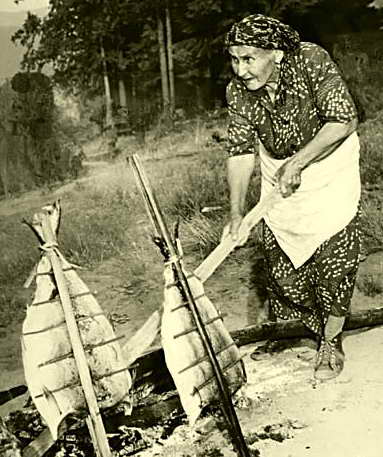
An elder of the Tsleil-Waututh Nation cooking salmon, c. 1940. 
Photo Vancouver City Archives, source www.firstnations.eu
 
Part 2

According to most aboriginal witnesses [1] who testified at the Commission this week, DFO's lack of interest in the aboriginal worldview goes farther than its dismissal of traditional knowledge. The agency is convinced that it is the only actor to possess valid (read “scientific”) knowledge in all things salmon, and so, it has quite logically concluded that it should also hold a monopoly over decision-making power. DFO did consult with us in the beginning, Joe Becker of the Musqueam said, but now it's more like a dictatorship where agreements are presented to us on a take it or leave it basis, and if you leave it, then you don't get to fish. Councillor June Quipp: We have no part in the management of the fisheries. We may sit at a table with DFO people, but they believe we are so low on the totem pole, we have no authority. Chief Robert Mountain: We have attended some of DFO's meetings, but we are not part of their decision making process. DFO communicates us its decisions. That needs to change.

One particular manifestation of this process of disempowerment, according to the witnesses, is a bad habit – or perhaps is it a conscious tactic? – developed by DFO to send subordinate staff, who have no negotiating mandate or decision power whatsoever, to meetings with the aboriginal leadership. This has the result of preventing any true negotiation from actually taking place, in spite of DFO's clear mandate to carry out such negotiations with the First Nations. Chief Robert Mountain: We had our chiefs present at the table with DFO, and so we would like DFO to send their own decision makers, so that decisions can actually be made. Otherwise, we are not on a same footing.

Grand Chief Clarence Pennier:

We need a good level of understanding with senior officials from DFO. Right now, we are just dealing with people who are coming to put documents on our table and tell us 'this is what you are entitled and not entitled to'. That does not constitute negotiation.

[ Question from legal counsel: Do you mean to say that DFO representatives who meet with you don't have a mandate to negotiate? ]

Answer: That's right. They don't.

Such practices have led to the development of what several aboriginal witnesses have described as a culture of harassment and abuse of power on the part of DFO towards indigenous communities. The witnesses provided the Commission with numerous concrete examples of how this abusive relationship manifests itself.

Councilor June Quipp, about DFO's petty decisions over ceremonial rights to fish:

I recently put a request with DFO for a ceremonial permit. I asked them for the right to harvest one fish for a ceremony, and my request was denied. And this was in 2010!

DFO has recently taken upon themselves to define what constitutes our ceremonial practices. But they have only defined death so far. So – you have to die to be allowed to set the table.

Rod Naknakim, about the inadequate terms of the fishing permits granted by DFO:

Our fishing permit extends for only 12 hours for the entire season... It's hard to teach the young generations about fishing practices in such conditions, because you want to make sure you optimize your 12 hours on the water.

President Guujaaw of the Haida, about unequal treatment over access to the resource:

It became evident that DFO's efforts were focused specifically on our people. I was charged and convicted for taking 27 pink salmon and I spent 2 days in jail, while the industry took 750,000 from the same watershed without running into any difficulties.

Councilor June Quipp again, about paternalistic and redundant sharing of “scientific information”:

DFO was organizing those telephone conference calls on global warming. One year, my sister noticed that the water in the river was warmer but also higher than usual. She gets on the conference call, where a DFO biologist makes that exact same comment. And so she told me: do I really need to get on a conference call to hear something that I already know?

Chief William Charlie, about how DFO's dismissal of traditional knowledge has led that agency to make ill-informed decisions which were detrimental to the salmon:

We would use torch lighting in the in shallow parts of the river. You would build a fire on your canoe which would attract the salmon and that would allow you to pick and choose which salmon you want to fish. This practice had been banned for years by DFO on “conservation” grounds. We have finally been able to reassert ourselves and make the case that it's a selective technique.

A particularly telling exchange took place between the lawyer representing the Ministry of Justice, who was defending the position of DFO, and Chief Newman of the Heiltsuk. This tense dialogue illustrates the two incompatible logics as well as the power struggle taking place over the salmon numbers:

Dept. Justice: The number of fish allocated for food, social and ceremonial purposes (FSC) – those numbers have been stable for years, right?

Chief Newman:Yes. That's because DFO sets those numbers for us and we have no input whatsoever in setting them.

Dept. Justice: But your nation does not even come near to using its allocation.

Chief Newman: Like I said earlier, things have been bad and so there are not enough fish for us to live on.

Dept. Justice: But you don't meet your allocation –

Chief Newman: Because there is nothing for us to fish!

Dept. Justice: You are not catching your allocation because the fish are not there?

Chief Newman: That's right.

Dept. Justice: There is no sense then in bumping up those numbers, since the fish are not there.

Chief Newman: But we want the government to know what our needs are. If the fish do come back, we want to be able to harvest them.

One of the most striking comments about DFO's disregard for aboriginal knowledge and culture came from Doctor Ron Ignace of the Skeetchestn: [2]

There was a time when they tried to take the Indian out of the child. The way I see it now, the way the fisheries are being operated, it’s like they are trying to take the fish out of the Indian... The younger generation of the last 20 years have lost the knowledge of how to fish with a spear in the river... they have lost the language to communicate. That practice is lost to us.

The First Nations are responding to what they perceive as DFO's assault on their knowledge, culture, and way of life by formulating some key demands:

  1. Reclaim control over their traditional knowledge. We need funding from the government so we can hire our own biologists on the river, Grand Chief Clarence Pennier said. Councilor June Quipp: We need our own biologists. We have many people who have a lot of knowledge, having lived on the river, knowing the signs and symbols that we use, people versed in our traditional knowledge.
  2. Redefine co-management of the salmon resource to be precisely what it was supposed be: a “co” management between two equal partners. Chief William Charlie: Co-management means that we can sit down and come up with ways to go forward, as opposed to DFO's attitude of 'this is the deal, sign here, or else you cannot fish'.
  3. Reassert the fundamental right of aboriginals to harvest fish for their traditional needs and subsistence. Assert that right by force, if needed. President Guujaaw of the Haida gave the following example involving Copper River: it was a sockeye stream under management of DFO. It went down to a few hundred fish, so our people just took over the river. We did not fish there for several years, and today it's producing salmon again.

A more radical approach has been tested by the Haida over the years, rather successfully it appears: ignore DFO altogether, return it the favor of considering the “other party” as powerless and irrelevant. President Guujaaw:

We don't go to DFO for permits anymore. We have no respect for DFO in their management of the resources. Twenty-five years ago in Gwaii Haanas, we set up some blockades and we stopped logging in that area. The Federal government cut a deal. All our rights remain intact: we can hunt, fish, trap, live there, cut trees, and do all the things our ancestors did for generations without impacting the land. Now, management has really become management of the visitors in the area, determining the quotas of how many people we should allow in.

What a spectacular reversal of fortune for both the Haida and the salmon – Think about it. In the southern half of Haida Gwaii, stewardship of the salmon is no longer measured in the number of fish that can be harvested, but in the number of people who are allowed in! And it really does make sense, it simply requires another system of knowledge, of values, of economic priorities to take the place of the old one.

I left those extraordinary three days of testimony wondering whether the Haida were not onto something with their unconventional, yet decisive, treatment of what must be called “the DFO question”. When a governmental institution behaves towards your people as a neo-colonial power, ignoring its most basic contractual and treaty obligations, dismissing your ancestral knowledge and culture as being child play, and – to add insult to injury – depleting the resource that it is supposed to protect while arrogantly lecturing you on what constitutes good stewardship, should you not indeed declare such an institution irrelevant and simply walk away from it?

To anyone who has attended some of the hearings at the Cohen Commission – not just those three days dedicated to the First Nations – it is pretty clear that this Inquiry has turned into the trial of DFO. Show up at the Commission on any random day, and you will have a good chance of either hearing some witness blast DFO, or some DFO bureaucrat attempt to survive the heavy artillery barrage fired at him/her by an army of lawyers representing groups who have to deal with DFO in their daily lives. This raises a fundamental question. Is DFO, this broken institution, reformable? Or is it simply beyond repair and must be abolished at the Federal government's earliest convenience, to avoid a growing section of civil society from following the lead of the Haida, and simply declaring DFO's authority not applicable to them? Perhaps one of the primary contributions of this Commission will be to help answer this fundamental question. To be continued, then, in January.


[1] I am using quotes from aboriginal leaders which I transcribed to the best of my ability as the testimonies were being given at the Commission. While my transcriptions accurately convey the meaning of what was said, they may not always reflect the exact words used by the witnesses. For that, we will have the official transcripts which should be posted on the Commission's website within the next couple weeks. To indicate that my quotes are true in their content yet not necessarily exact in their form, I am using italics and no quotes whenever quoting an aboriginal witness.

[2] I was not present on the second day of the testimonials and so for those, I am relying on the transcripts provided by fellow activist Elena Edwards.

.